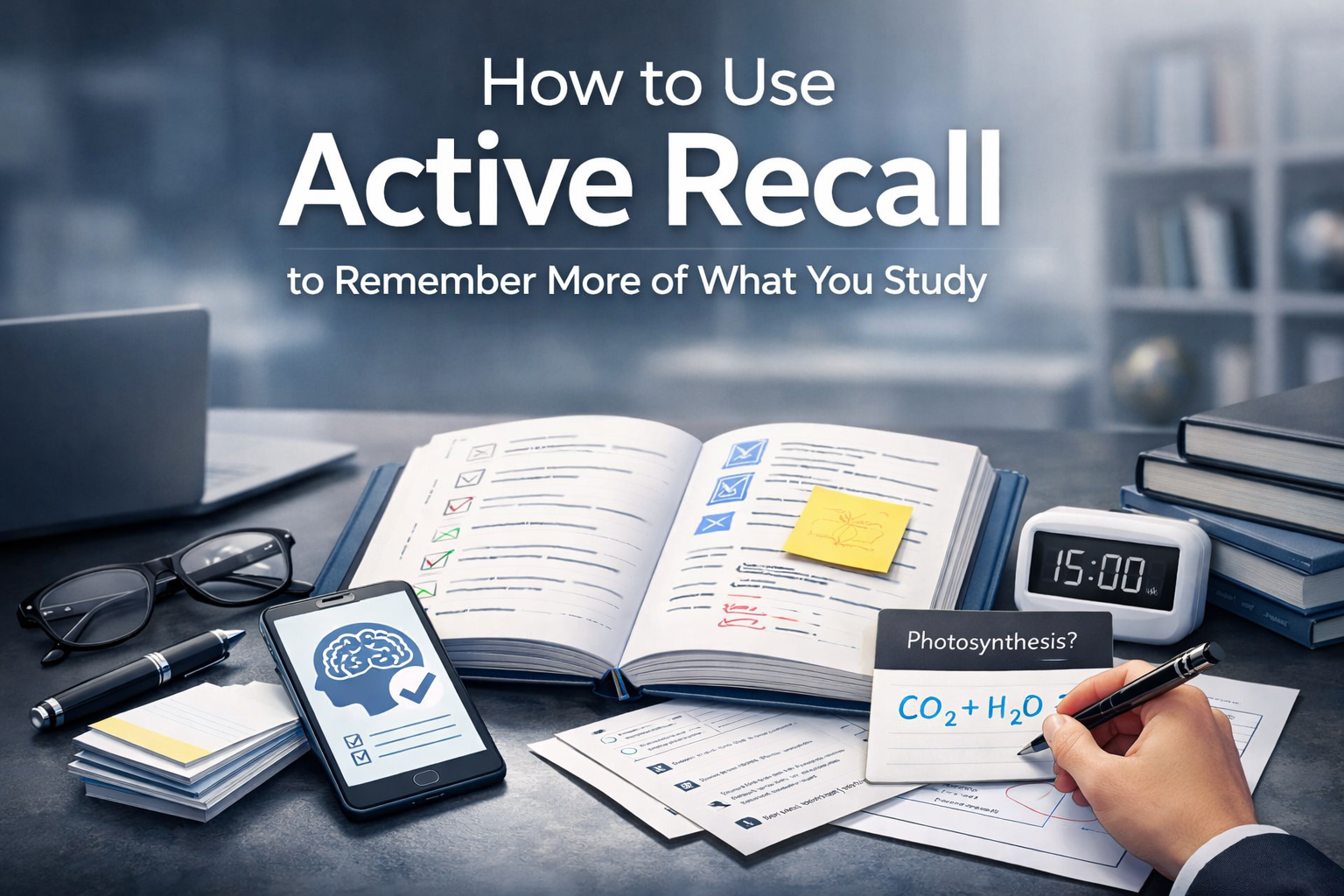
If you keep forgetting what you study, active recall is one of the best places to start. Instead of rereading notes and hoping the information sticks, active recall helps you test whether you can actually bring it back from memory.
Done well, it can make revision more honest, more effective, and much easier to trust. Here’s what active recall is, why it works, and how to use it properly.
What Is Active Recall?
Active recall is a study method where you stop looking at the answer and force yourself to bring it back from memory. Instead of rereading notes, highlighting lines, or replaying the same video, you test whether you can actually produce the idea on your own.
That might mean answering a question without looking, writing down everything you remember from a topic, or explaining a concept out loud from memory.
This matters because familiarity is not the same as memory. Something can look clear on the page and still disappear the next day in an exam. Active recall closes that gap. It shows you what you truly know, reveals weak spots quickly, and turns passive study into lasting recall.
For example, after revising a biology topic, a student closes their notes and writes down everything they can remember before checking what they missed. That simple act of retrieval is often far more effective than reading the same page again.
Expert view: Psychologist Henry Roediger’s research helped show that testing yourself is not just a way to measure learning — it can improve it. In one influential study, students who retrieved information from memory retained more on delayed tests than students who simply restudied the material. As the authors put it, “Testing is a powerful means of improving learning, not just assessing it.”
Why Active Recall Works Better Than Rereading
Rereading feels productive because the material becomes familiar. But familiarity can be misleading. Seeing an answer again is much easier than producing it from memory on your own.
Active recall works better because it forces your brain to retrieve the information. That process strengthens memory and makes it easier to access later in an exam, essay, or problem set. Research on the testing effect has repeatedly found that retrieving information improves later retention more than simply studying it again.
This is why students often leave a revision session feeling confident after rereading, then struggle to remember the material the next day. The page looked familiar, but the memory was not strong enough to stand on its own.
A simple way to think about it is this: rereading helps you recognise information, but active recall helps you reconstruct it. And exams rarely reward recognition alone. They reward being able to pull ideas back, connect them, and use them under pressure.
That is why even a short brain dump, a few flashcards, or answering your own questions from memory can do more for long term retention than another pass through your notes. Reviews of learning techniques rate practice testing as a high utility method for students across many subjects and settings.
How to Use Active Recall Step by Step
Start with a small chunk of material, not an entire chapter. Read one section of notes, one topic, or one set of slides, then close everything and try to bring the key ideas back from memory.
Write down what you remember, answer a question without looking, or explain the topic out loud in your own words.
Then check for gaps. Compare your recall against your notes, correct what you missed, and test yourself again later. That is where active recall becomes powerful: it does not just show you what feels familiar it shows you what you can actually retrieve when the answer is no longer in front of you.
A simple student version looks like this: revise a biology process for 15 minutes, close your notes, and write out every step from memory on a blank page. Then check what you missed, tighten the weak spots, and repeat.
You can use the same method with flashcards, practice questions, essay plans, formulas, or lecture headings turned into questions.
The rule is simple: study, hide, recall, check, repeat.
If you cannot explain it without looking, you do not know it well enough yet. That is the moment to test yourself again not reread for comfort.
Best Active Recall Methods for Students
Not all active recall has to look the same. The best method is usually the one you will actually repeat, so choose a format that fits the subject you are studying.
A few of the most useful options are simple:
Flashcards
Flashcards work well for facts, vocabulary, definitions, and formulas. The key is to try to produce the answer before flipping the card, not just glance at both sides.
Brain Dumps
Brain dumps are powerful for essay subjects or larger topics. You close your notes and write down everything you can remember on a blank page, then compare it against the source material.
Past Paper Questions
Past paper questions are ideal when you need recall under exam conditions. They help you practise retrieval in a way that is closer to the real thing.
Turning Headings Into Questions
This works especially well for lecture slides and textbooks. Instead of rereading a heading, turn it into a question and answer it from memory.
The method matters less than the principle: if the answer is in front of you, it is not active recall yet.
Common Active Recall Mistakes
One of the biggest mistakes is doing recognition instead of recall. If you leave the notes open, glance at the answer too quickly, or rely on prompts too early, it can feel like you know the material when you only recognise it.
Another mistake is making recall too big or too vague. Testing yourself on an entire chapter usually leads to overwhelm, not better memory. It works better when you break the material into smaller chunks, retrieve one idea at a time, then check and correct.
Students also often quit too early because active recall feels harder than rereading. That difficulty is part of the benefit. Retrieval practice can feel less fluent in the moment, even while producing better retention later.
A final mistake is using active recall once and never coming back to it. Recall gets much stronger when you repeat it over time, which is why active recall works best when paired with spaced repetition.
A Simple Active Recall Routine for Today
Start with one topic, not five. Study it for 10 to 15 minutes, then close your notes and try to bring the main ideas back from memory on a blank page.
Write down the key points, steps, definitions, or arguments as clearly as you can.
Then check what you missed. Open your notes, compare them against your recall, and mark the weak spots. Spend a few minutes tightening those gaps, then test yourself again later the same day or the next day.
A simple version looks like this:
study → hide → recall → check → repeat
That keeps revision active, honest, and focused on what you actually need to remember.
Active Recall, Spaced Repetition, and Working Memory
Active recall gets even stronger when you pair it with spaced repetition. Instead of testing yourself once and moving on, you come back to the material after a gap just as it starts to fade and retrieve it again. Reviews of learning strategies rate both practice testing and distributed practice as high utility techniques for improving retention.
It also helps to understand working memory. Working memory is the small mental workspace you use to hold and work with information in the moment, and it is closely tied to attention and learning. When that system is overloaded by distraction, fatigue, or too much information at once, studying feels harder and recall becomes less reliable.
So the simple model is this:
- Active recall helps you pull information out
- Spaced repetition helps you revisit it before it disappears
- Working memory affects how easily you can keep the task in mind while learning
That is why the best study systems do not rely on one trick. They combine retrieval, timing, and attention support.
If you want to make studying feel less passive and more effective, active recall is one of the best habits to build first.
Sources
- Roediger HL, Karpicke JD. Test-enhanced learning: taking memory tests improves long-term retention. Psychological Science. 2006.
- Karpicke JD, Roediger HL. The critical importance of retrieval for learning. Science. 2008.
- Dunlosky J, Rawson KA, Marsh EJ, Nathan MJ, Willingham DT. Improving Students’ Learning With Effective Learning Techniques. Psychological Science in the Public Interest. 2013.
- Baddeley A. Working memory. Science. 1992.