
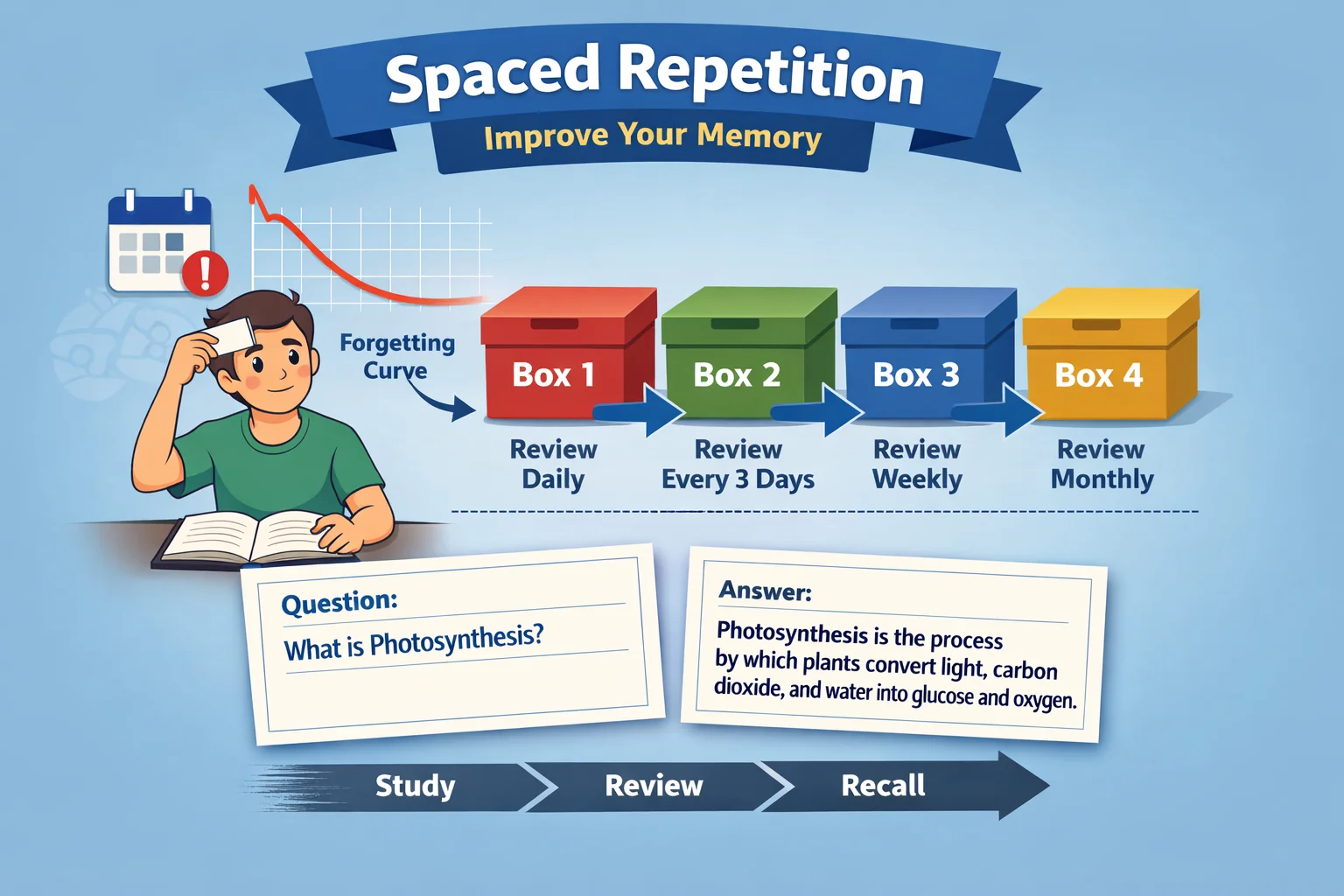
As time goes by, we naturally lose our ability to recall information.
Spaced repetition is a learning technique that improves long-term memory by reviewing information over planned intervals. Rather than repeating something again and again in one sitting, you come back to it after a delay.
The goal is to revisit material before you forget it completely, so each review helps strengthen the memory. This helps combat the forgetting curve the tendency for the brain to forget information over time, as described by Hermann Ebbinghaus.
In a large study on how to maximise long-term retention, Cepeda et al. found that the best spacing interval increased final recall by 64% and final recognition by 26% compared with a zero-day gap.
Spacing effects in learning: A temporal ridgeline of optimal retention - PubMed
Spaced repetition works because it interrupts forgetting. When you return to material after a gap, you have to work a little harder to retrieve it, and that extra effort helps strengthen the memory.
This is why one long revision session can feel productive, only for the information to fade a few days later. The material felt familiar, but it was not reinforced over time.
Cramming helps you remember for tomorrow. Spaced repetition helps you remember for longer.
How to Use Spaced Repetition: The Leitner Box System
One of the simplest ways to use spaced repetition is through the Leitner box system, which uses flashcards to improve long-term memory.
A flashcard is a card (physical or digital) used to support memorisation. One side contains a question, and the other contains the answer.
For example:
- Front: How does photosynthesis work?
- Back: Photosynthesis is the process plants use to turn light, water, and carbon dioxide into glucose and oxygen.
The core of the system is a set of boxes — usually 3 to 5 — that hold your flashcards.
How it works
1. Setup
All new flashcards start in Box 1.
2. Review
- Correct answer: Move the card to the next box.
- Incorrect answer: Move the card back to Box 1.
3. Review frequency
Each box is reviewed at a different interval:
- Box 1: Daily
- Box 2: Every 2 to 3 days
- Box 3: Once a week
- Box 4: Once a fortnight
- Box 5: Once a month
This means the material you know well is reviewed less often, while the cards you struggle with appear more frequently.
The Leitner system can be used to learn almost anything: definitions, vocabulary, formulas, dates, or key processes. Revisiting information after time has passed helps strengthen memory and improves recall over the long term.
How Spaced Repetition Works with Active Recall
Spaced repetition works best when it is paired with active recall. Active recall is a study method that improves memory by forcing you to retrieve information from your mind instead of simply rereading it.
Spaced repetition tells you when to review.
Active recall tells you how to review.
Used together, they make revision more effective and improve long-term memory.