


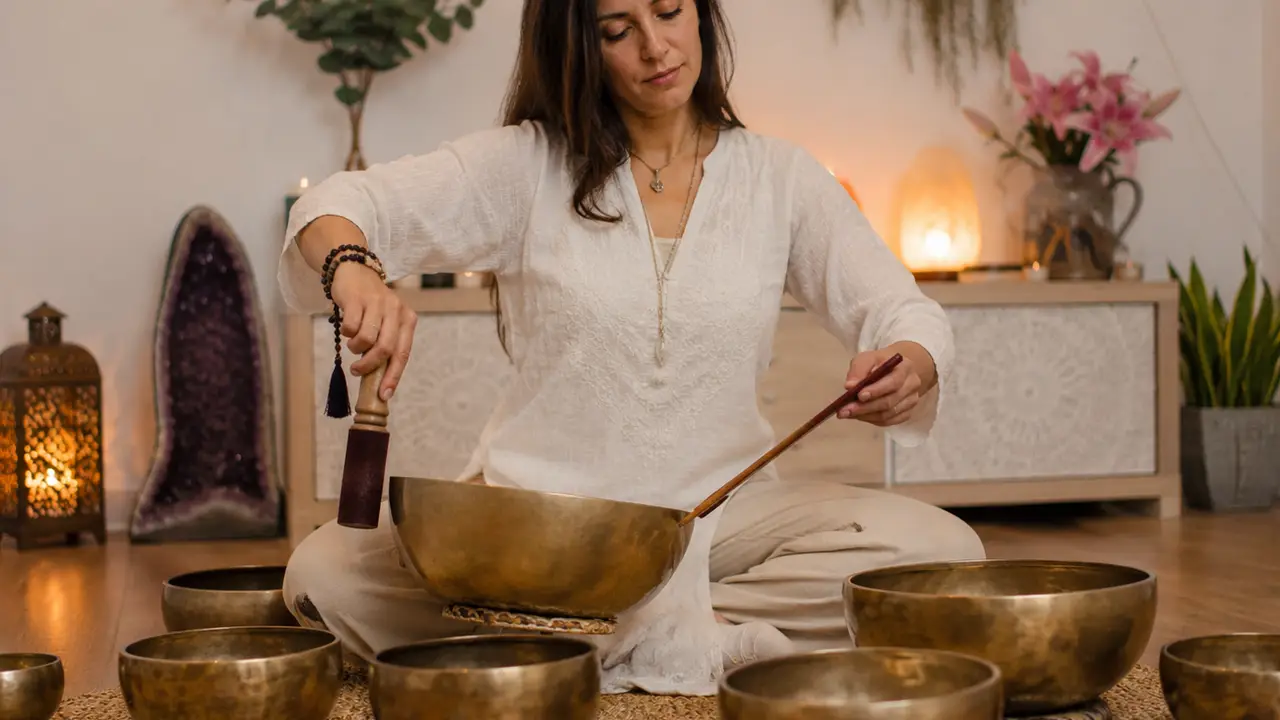
Is There a Best Frequency for Meditation?
No individual sound frequency has been proven to be universally best for meditation, relaxation or healing.
Sound may help by providing an attention anchor, masking unpredictable background noise or creating a pleasant and consistent environment. Volume, rhythm, predictability, personal preference and context may be more important than a frequency printed on a recording.
You may genuinely prefer music tuned to 432 Hz, the sound of rainfall or the tone of a particular singing bowl. That preference can support your practice without proving that the sound has a unique medical or spiritual effect.
What Is a Sound Frequency?
Sound frequency is measured in Hertz, abbreviated to Hz. One hertz means one vibration cycle per second.
Human hearing is commonly described as extending from approximately 20 Hz to 20,000 Hz, although sensitivity varies by age, hearing health, volume and individual physiology.
Frequency mainly influences how high or low a sound is perceived:
- Lower frequencies are generally heard as deeper sounds
- Higher frequencies are generally heard as brighter sounds
- Very low frequencies may be felt as vibration when sufficiently powerful
- Frequencies above an individual’s hearing range cannot be consciously heard
Frequency is only one characteristic of sound.
| Term | What it describes | What it does not establish |
|---|---|---|
| Frequency — Hz | Cycles per second and perceived pitch | A specific health benefit |
| Volume — dB | Sound intensity or level | Whether a sound is calming |
| Tempo — BPM | Musical beats per minute | Brainwave frequency |
| Timbre | The character or tonal colour of a sound | Its therapeutic effectiveness |
| Tuning reference | The pitch used to tune other notes | The frequency of the entire recording |
| Modulation or beat | A repeating change within a sound | Guaranteed brainwave entrainment |
A recording cannot be judged by its frequency label alone.
Singing Bowls and Sound Frequencies
A singing bowl does not produce just one frequency.
When struck or played around the rim, it normally produces:
- A fundamental or prominent tone
- Several higher and lower partials
- Changing overtones
- Fluctuations in volume
- Beating patterns created by closely spaced frequencies
Some of these partials may not follow the neat harmonic pattern produced by a stringed instrument. This complexity helps give each bowl its individual sound.
A bowl’s sound is influenced by:
- Diameter and depth
- Wall thickness
- Shape of the rim
- Metal composition
- Manufacturing differences
- Mallet material
- Where and how firmly it is struck
- The surface supporting it
A seller might identify one prominent pitch, but that measurement does not describe the complete sound. It also does not establish that the bowl can treat a corresponding organ, chakra or emotional condition.
Learn more about how to play a Himalayan singing bowl and how bowls can support meditation practice.
What Is Coloured Noise?
Coloured noise contains a broad range of frequencies. Its “colour” describes how sound energy is distributed across those frequencies—not a guaranteed effect on sleep, focus or health.
White Noise
White noise contains approximately equal power within each equal-width frequency band. Because this gives considerable energy to higher frequencies, it is often perceived as a bright hiss.
It can mask variable environmental sounds, but some people find it harsh or tiring.
Pink Noise
Pink noise contains less energy as frequency increases—approximately three decibels less per octave. It is often perceived as softer and more balanced than white noise.
Rain, wind and ocean recordings are sometimes described as pink noise, although real natural sounds do not necessarily follow a perfect pink-noise spectrum.
Brown Noise
Brown noise decreases more strongly at higher frequencies—approximately six decibels per octave. This produces a deeper, bass-heavy sound.
Its name refers to Brownian motion rather than the colour brown. Despite its popularity in focus and meditation playlists, direct clinical evidence for special benefits from brown noise remains limited.
| Noise type | Typical perception | Possible practical use | Evidence |
|---|---|---|---|
| White | Bright, steady hiss | Masking varied background noise | Mixed |
| Pink | Softer and more balanced | Masking, relaxation or sleep routines | Mixed |
| Brown | Deep and bass-heavy | Personal focus or meditation preference | Very limited |
| Silence | No added sound | Sleep or meditation when the environment permits | Often worth testing first |
Does Coloured Noise Improve Sleep?
Research does not support a simple claim that pink noise improves deep sleep or memory.
A 2022 systematic review examined 34 studies of auditory stimulation during sleep. Although several studies reported positive results, the authors found no strong overall evidence supporting white or pink noise.
A controlled 2026 laboratory study produced a more cautionary result. Twenty-five adults completed seven nights under different sound conditions. Continuous pink noise at 50 dBA reduced REM sleep compared with a quiet control night. It masked some disruption from intermittent environmental noise, but combining the two also worsened parts of the participants’ sleep structure.
Specially timed sounds used in sleep laboratories should not be confused with playing continuous pink noise all night. Laboratory systems may deliver brief sounds at carefully selected stages of sleep, often using EEG monitoring.
Practical conclusion: Coloured noise may mask an irritating environment, but it should not automatically be assumed to improve sleep. Use the lowest comfortable volume and compare it with a quiet night.
Nature Sounds and Relaxation
Natural soundscapes may provide a more varied alternative to synthetic noise.
A 2021 systematic review and meta-analysis found that exposure to natural sounds was associated with improved positive affect and reductions in stress and annoyance. Water sounds produced some of the strongest results for health and positive-affect outcomes.
However, there is no fixed frequency range for “ocean waves”, “rain” or “forest sounds”. Their acoustic content changes with:
- Weather and location
- Distance from the sound
- Recording equipment
- Background wildlife
- Water movement
- Wind intensity
- Audio editing and playback equipment
| Soundscape | Useful characteristic | Possible limitation |
|---|---|---|
| Steady rain | Predictable and effective at masking interruptions | High-frequency detail can feel sharp |
| Ocean waves | Slow changes can provide a listening rhythm | Sudden waves may distract some listeners |
| Flowing water | Continuous sound with natural variation | Some people find it stimulating |
| Forest ambience | Detailed and immersive | Bird calls may repeatedly attract attention |
| Wind | Gentle and relatively consistent | Strong gusts can be unpredictable |
Pleasantness matters. A natural sound you associate with safety or enjoyment may be more relaxing than one you dislike, regardless of its spectrum.
What Does “432 Hz Music” Actually Mean?
Music labelled “432 Hz” is usually not a single 432 Hz tone.
It normally means that the note A above middle C—A4—has been used as a tuning reference at 432 Hz. Other notes are tuned relative to it. Standard modern tuning commonly places A4 at 440 Hz.
Changing from A4 = 440 Hz to A4 = 432 Hz shifts the entire piece slightly lower in pitch. It does not convert every sound in the music into 432 Hz.
Small pilot studies have reported differences between music tuned to 432 Hz and 440 Hz. For example:
- A 2019 crossover study involving 33 people reported a slightly greater reduction in heart rate after 432 Hz music
- A 2020 pilot study involving 12 patients with spinal-cord injuries reported improved subjective sleep scores with preferred music tuned to 432 Hz
These results are preliminary. Small samples, subjective outcomes, musical preferences and differences introduced during pitch conversion make the findings difficult to generalise.
There is currently no robust evidence that:
- 432 Hz is inherently healing
- It is the natural frequency of the Earth or human body
- 440 Hz is harmful
- Everyone will find 432 Hz more relaxing
If you prefer the slightly lower sound of 432 Hz music, it remains a perfectly reasonable choice for meditation.
What About 528 Hz?
528 Hz is frequently described online as the “love frequency” and is sometimes claimed to support transformation, DNA repair or cellular healing.
One 2018 experiment compared short exposures to music described as 528 Hz and 440 Hz in nine participants. The researchers reported differences in some mood and salivary measurements.
Nine participants and a brief exposure are not enough to establish a reliable or clinically meaningful effect. The study also does not demonstrate DNA repair or prove the wider claims attached to 528 Hz.
Listening to 528 Hz music may feel pleasant. It should not be described as repairing DNA, regenerating cells or treating a health condition.
What Are Solfeggio Frequencies?
Recordings marketed as Solfeggio frequencies commonly include:
- 174 Hz
- 285 Hz
- 396 Hz
- 417 Hz
- 528 Hz
- 639 Hz
- 741 Hz
- 852 Hz
- 963 Hz
Online wellness sources associate these numbers with outcomes such as security, emotional release, relationships, intuition and spiritual awareness.
These are spiritual or marketing associations, not established acoustic or medical effects. There is no high-quality evidence showing that each frequency produces its advertised emotional outcome.
You may use these recordings as part of a personal spiritual practice. The distinction is simply that personal meaning should not be presented as scientific proof.
Are Meditation Frequencies the Same as Brainwaves?
No. Sound frequency and brainwave frequency are different measurements.
Theta brain activity, for example, is generally discussed within approximately 4–8 Hz. A pure acoustic tone at that frequency is below the usual range of human hearing.
Recordings described as “Theta sounds” therefore use audible tones containing a slower pulse or modulation. Binaural-beat recordings present slightly different audible tones to each ear, creating the perception of a third rhythmic difference.
Hearing a rhythm within the Theta range does not guarantee that the brain enters a Theta state or that deep meditation will occur.
Read more about singing bowls and binaural beats and our explanation of brainwaves during singing-bowl meditation.
What Probably Matters More Than a Frequency Label?
When choosing a meditation sound, consider:
- Pleasantness: Do you genuinely enjoy the sound?
- Predictability: Does it settle your attention or repeatedly surprise you?
- Volume: Is it comfortably audible without feeling intrusive?
- Complexity: Do you prefer one sustained tone or a detailed soundscape?
- Rhythm: Does the pace support your intended practice?
- Personal associations: Does the sound feel familiar or emotionally safe?
- Environment: Is it helping to mask noise, or adding more stimulation?
- Purpose: Are you meditating, concentrating, relaxing or trying to sleep?
The best sound is often the one that makes it easier to continue the practice—not the one with the most impressive numerical claim.
A Simple Personal Sound Test
You can compare different meditation sounds without knowing their advertised benefits in advance.
Choose three options, such as:
- A singing-bowl recording
- Steady rain
- Pink or brown noise
Listen to each for ten minutes on separate days, at approximately the same time and volume.
Before and after each session, score the following from 0 to 10:
| Measure | Before | After |
|---|---|---|
| Physical tension | ||
| Mental distraction | ||
| Calmness | ||
| Ability to remain present | ||
| Pleasantness of the sound |
Repeat each sound more than once. This will tell you more about your response than its title, frequency claim or popularity.
You can also compare different sound-meditation instruments.
Listen Safely
Volume and duration are more important to hearing safety than whether a recording uses 432 Hz, pink noise or singing bowls.
The World Health Organization advises that listening time decreases rapidly as volume rises. Its adult reference is up to 40 hours per week at an average of 80 dB, falling to four hours per week at 90 dB.
For meditation:
- Use the lowest comfortable volume
- Keep speakers and singing bowls away from your ears
- Take breaks during extended listening
- Avoid using headphones to overpower external noise
- Stop if you experience discomfort, pain, dizziness or increased tinnitus
- Do not leave continuous noise playing all night by default
Frequently Asked Questions
What frequency is best for healing?
No sound frequency has been proven to heal the body or treat a medical condition. Sound may nevertheless support relaxation, enjoyment or meditation.
Is 432 Hz better than 440 Hz?
Small studies have reported possible differences, but the evidence is not strong enough to establish 432 Hz as superior. Personal preference is a reasonable guide.
Does 528 Hz repair DNA?
There is no credible evidence that listening to 528 Hz music repairs human DNA.
Is pink noise better than white noise?
Pink noise often sounds softer, while white noise may mask a wider range of interruptions. Neither is universally better, and evidence for improving sleep is mixed.
Is brown noise scientifically proven to improve concentration?
Direct evidence remains limited. Some people find its deeper sound less distracting, but that is not a guaranteed cognitive effect.
Can I hear Theta frequencies?
A pure 4–8 Hz tone is below the usual human hearing range. “Theta” recordings use audible carrier tones, rhythmic modulation or binaural differences.
Finding the Sound That Works for You
Sound does not need a special numerical label to be useful.
A singing bowl can provide an engaging attention anchor. Rain may cover distracting traffic. Brown noise might feel comfortable, while someone else may prefer complete silence.
Rather than asking which frequency is universally best, ask a more useful question:
Which sound helps me remain comfortable, attentive and present at a safe volume?
References
- Buxton, R. T. et al. (2021), “A Synthesis of Health Benefits of Natural Sounds and Their Distribution in National Parks”, Proceedings of the National Academy of Sciences.
- Capezuti, E. et al. (2022), “Systematic Review: Auditory Stimulation and Sleep”, Journal of Clinical Sleep Medicine.
- Basner, M. et al. (2026), “Efficacy of Pink Noise and Earplugs for Mitigating the Effects of Intermittent Environmental Noise Exposure on Sleep”, Sleep.
- Calamassi, D. and Pomponi, G. P. (2019), “Music Tuned to 440 Hz Versus 432 Hz and the Health Effects”, Explore.
- Calamassi, D. et al. (2020), “Music Tuned to 432 Hz Versus Music Tuned to 440 Hz for Improving Sleep in Patients with Spinal Cord Injuries”, Acta Biomedica.
- Akimoto, K. et al. (2018), “Effect of 528 Hz Music on the Endocrine System and Autonomic Nervous System”, Health.
- World Health Organization (2026), “Deafness and Hearing Loss: Safe Listening”.