Working memory is your brain’s ability to hold information in mind and use it at the same time.
You use it when you follow instructions, solve problems, do mental maths, read a long sentence, remember directions, or keep track of what someone just said while planning your reply.
Because working memory is limited, it can become overloaded quickly.
That does not mean your memory is broken. It usually means your brain is trying to hold too much information at once.
The good news is that you can support working memory with practical exercises and better habits.
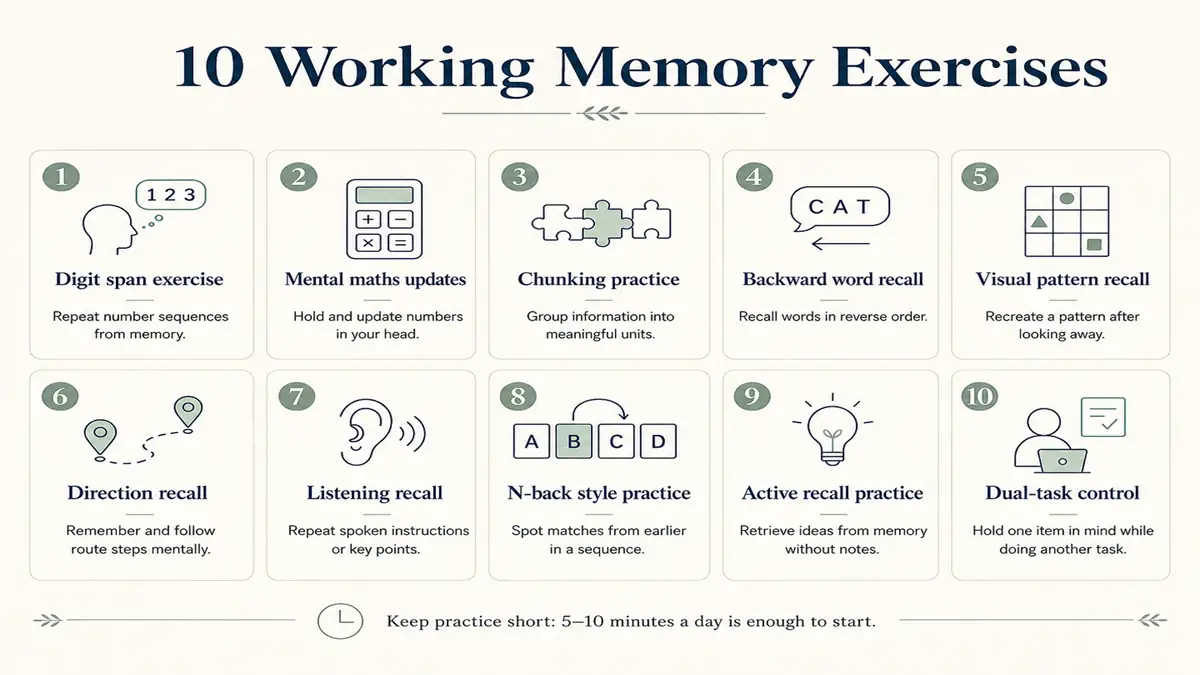
In this guide, you’ll learn 10 working memory exercises you can try at home, while studying, or during a short brain-training session.
First: can working memory actually improve?
Working memory can be trained and supported, but it is important to be realistic.
You may get better at specific working memory tasks with practice. For example, if you practise remembering number sequences, visual patterns, or mental updates, those tasks may become easier over time.
However, getting better at one exercise does not automatically mean every part of memory, intelligence, or learning will improve.
The best approach is to combine working memory exercises with:
- good sleep
- regular movement
- focused study
- active recall
- spaced repetition
- reduced distractions
- healthy routines
- practical memory strategies
Working memory exercises are useful, but they work best as part of a bigger system.
Related guide: What Is Working Memory? A Simple Guide With Examples
How to use these exercises
You do not need to do all 10 exercises every day.
A simple routine is enough:
- choose 2 or 3 exercises
- practise for 5 to 10 minutes
- make the task slightly harder over time
- stop before you feel completely drained
- track your progress
The aim is not to make practice stressful. The aim is to gently challenge your ability to hold, update, and use information.
1. Digit span exercise
The digit span exercise trains your ability to hold information briefly.
Start with a short sequence of numbers.
Example:
4 – 8 – 2
Look away and repeat the numbers in the same order.
Then try a longer sequence:
7 – 1 – 9 – 3
Then:
5 – 2 – 8 – 6 – 4
How to do it
- Write down or generate a random number sequence.
- Look at it for 3 to 5 seconds.
- Cover it.
- Repeat it from memory.
- Add one extra digit when it becomes easy.
Make it harder
Try repeating the digits backwards.
Example:
4 – 8 – 2
Answer:
2 – 8 – 4
Backward recall is harder because you have to hold and manipulate the information.
That makes it more of a working memory exercise, not just a short-term memory exercise.
2. Mental maths updates
Mental maths is a strong working memory exercise because you need to hold numbers in mind while changing them.
Start simple.
Example:
Start at 10.
Add 4.
Subtract 2.
Add 7.
What is the answer?
Answer:
19
You are not just remembering a number. You are updating it step by step.
How to do it
Try examples like:
Start at 20. Add 5. Subtract 3. Double it.
Or:
Start at 50. Subtract 10. Add 6. Divide by 2.
Make it harder
Increase the number of steps.
Example:
Start at 12. Add 8. Subtract 5. Add 11. Divide by 2. Add 4.
You can also use multiplication, division, percentages, or negative numbers once the basics feel easy.
3. Chunking practice
Chunking means grouping information into meaningful units.
Working memory is limited, so chunking helps reduce mental load.
For example, this is hard to remember:
1 4 9 2 1 7 7 6 1 9 4 5
This is easier:
1492 – 1776 – 1945
The information is the same, but it is grouped into meaningful chunks.
How to do it
Take a long string of information and group it.
Examples:
Numbers
447911245889
Becomes:
44 – 7911 – 245 – 889
Words
apple chair river glass train
Could become:
objects: apple, chair, glass
movement/place: river, train
Study notes
Instead of remembering 12 separate facts, group them under 3 or 4 headings.
Why it helps
Chunking reduces the number of separate items your working memory has to hold.
This is useful for studying, remembering lists, understanding complex ideas, and following multi-step tasks.
Related guide: The Best Memory Techniques to Remember More of What You Study
4. Backward word recall
Backward recall challenges working memory because you need to hold information and rearrange it.
Start with three words.
Example:
cat – river – book
Repeat them backwards:
book – river – cat
Then try four or five words.
Example:
apple – window – train – music
Answer:
music – train – window – apple
How to do it
- Choose 3 to 6 simple words.
- Read them once.
- Look away.
- Repeat them backwards.
- Increase the list length when it becomes easy.
Make it harder
Use words from a topic you are studying.
For example, if you are studying biology:
cell – nucleus – membrane – enzyme
Then repeat them backwards.
This makes the exercise more useful because it connects working memory practice with real learning.
5. Visual pattern recall
Working memory is not only verbal. It also includes visual and spatial information.
Visual pattern recall trains your ability to hold images, positions, and layouts in mind.
How to do it
Draw a simple 3x3 grid.
Mark 3 squares.
Look at the grid for 5 seconds.
Cover it.
Recreate the pattern from memory.
Example:
ext
X . .
. X .
. . X
Then cover it and redraw it.
Make it harder
Increase the grid size.
Try:
- 3x3 grid with 4 marked squares
- 4x4 grid with 5 marked squares
- 5x5 grid with 6 marked squares
You can also use colours, shapes, or symbols.
This is useful for visual memory, pattern recognition, and attention.
6. Direction recall
Direction recall trains verbal and spatial working memory together.
You need to hold a sequence in mind and mentally follow it.
Example:
Left, right, straight, second left.
Repeat it from memory.
Then imagine walking the route.
How to do it
Start with short direction sequences:
left – right – straight
Then increase the length:
left – straight – right – right – second left
Make it harder
Add landmarks.
Example:
Walk past the library, turn left at the café, cross the road, then take the second right.
This is useful because it feels similar to real-life navigation.
It also helps you practise holding multiple steps in order.
7. Listening recall
Listening recall is useful because many working memory challenges happen when someone gives you information out loud.
For example, a teacher explains a concept, a colleague gives instructions, or a friend tells you a plan.
How to do it
Ask someone to read a short sentence or instruction to you.
Example:
Bring your notebook, open page 12, underline the title, and answer question 3.
Then repeat the instruction back.
Solo version
Read a sentence out loud, look away, and repeat the key points.
Example:
Working memory helps you hold information in mind while using it for reasoning, learning, and problem-solving.
Now ask:
What were the three things working memory helps with?
Answer:
reasoning, learning, and problem-solving
Make it harder
Use longer sentences, study notes, podcast clips, or audiobook passages.
This can help with studying, meetings, lectures, and conversations.
8. N-back style practice
N-back is a common working memory exercise.
The basic idea is simple: you see or hear a sequence, and you have to identify when the current item matches one from a certain number of steps earlier.
Simple 1-back example
Look at this sequence:
A – B – B – C – D – D
In 1-back, you ask:
Is the current item the same as the one just before it?
Matches:
- B after B
- D after D
Simple 2-back example
Look at this sequence:
A – B – A – C – B
In 2-back, you ask:
Is the current item the same as the one two steps earlier?
Matches:
- A matches the A two positions earlier
- B matches the B two positions earlier
Why it helps
N-back tasks challenge working memory because you have to:
- hold recent items in mind
- update them constantly
- ignore older information
- respond when there is a match
Keep it realistic
N-back can be challenging and useful for practice, but it should not be treated as a magic shortcut to better intelligence.
Use it as one part of a balanced brain-training routine.
Related guide: Do Brain Training Games Actually Improve Memory?
9. Active recall practice
Active recall is one of the most useful memory strategies for studying.
It means testing yourself from memory instead of only rereading.
Although active recall is usually discussed as a long-term learning strategy, it also uses working memory because you need to retrieve, organise, and explain information in the moment.
How to do it
After reading a short section, close your notes and ask:
What were the main points?
Then write or say the answer from memory.
Example prompts:
- What are the three key ideas?
- Can I explain this without looking?
- What example proves this?
- How would I teach this to someone else?
- What question could appear in an exam?
Make it harder
Use a blank page.
Write everything you remember about a topic for 2 minutes.
Then check your notes and fill in the gaps.
Related guide: How to Use Active Recall to Remember More of What You Study
10. Dual-task control
Working memory is closely linked to attention.
A dual-task exercise trains you to hold one thing in mind while doing another simple task.
Start easy.
Example:
Remember the word “orange” while counting backwards from 30 by 3s.
When you finish, say the word you were remembering.
How to do it
Try combinations like:
- remember a word while walking across the room
- remember a number while sorting cards
- remember a short list while tapping a rhythm
- remember a direction sequence while drawing a simple shape
Make it harder
Increase the amount of information you hold.
Example:
Remember “orange, river, chair” while counting backwards from 50 by 4s.
Be careful
The goal is not to multitask all day.
This is a short exercise. For real studying, reading, writing, or problem-solving, single-tasking is usually better.
Related guide: Can’t Focus While Studying? 7 Brain-Based Fixes That Work
A simple 7-day working memory routine
Here is a simple routine you can try.
| Day | Exercises |
|---|---|
| Day 1 | Digit span + chunking |
| Day 2 | Mental maths updates + visual pattern recall |
| Day 3 | Backward word recall + listening recall |
| Day 4 | N-back style practice + active recall |
| Day 5 | Direction recall + dual-task control |
| Day 6 | Choose your 3 hardest exercises |
| Day 7 | Repeat your favourite 3 and track progress |
Keep each session short.
Aim for:
5 to 10 minutes per day
You should feel challenged, not exhausted.
How to make working memory exercises more effective
To get more from these exercises, follow a few simple rules.
1. Increase difficulty slowly
Do not jump from easy to impossible.
A good exercise should feel slightly challenging but still doable.
2. Track one score
Track something simple, such as:
- longest digit sequence remembered
- number of correct mental maths steps
- grid size completed
- number of words recalled backwards
- number of correct n-back matches
Progress is easier to see when you measure one thing.
3. Avoid overtraining
More is not always better.
Short, consistent practice is usually better than one long session that leaves you mentally tired.
4. Combine exercises with real learning
Working memory exercises are useful, but they are not enough on their own.
For studying, combine them with:
- active recall
- spaced repetition
- practice questions
- teaching the idea out loud
- sleep
- breaks
- focused attention
Related guide: Spaced Repetition to Remember More While Studying
Everyday ways to reduce working memory load
Improving working memory is not only about training. It is also about reducing unnecessary mental load.
Try these everyday strategies:
Use checklists
Checklists free your brain from holding every step at once.
Write down important details
If something matters, do not rely on memory alone.
Break big tasks into smaller steps
Instead of “revise biology”, write:
- review cell structure
- test key terms
- answer 5 questions
- check mistakes
- repeat weak areas
Remove distractions
Notifications, background tabs, and multitasking all compete for working memory.
Use visual aids
Tables, diagrams, mind maps, and notes can make complex information easier to manage.
Sleep properly
Tiredness can make working memory feel weaker, especially during demanding tasks.
Related guide: 10 Ways to Optimise Sleep for Better Memory
Working memory exercises for students
Students often rely heavily on working memory.
Studying requires you to hold new information in mind, connect it to what you already know, and apply it to questions.
The most useful exercises for students are:
- active recall
- mental maths updates
- backward word recall
- chunking
- listening recall
- visual pattern recall
A simple study routine could look like this:
- Read a short section.
- Close the notes.
- Write the main points from memory.
- Turn those points into questions.
- Review again tomorrow using spaced repetition.
This trains memory in a way that directly supports learning.
Related guide: How to Improve Memory: 8 Science-Backed Ways to Remember More
Working memory exercises for everyday life
You can also practise working memory during daily tasks.
Examples:
- remember a short shopping list without checking your phone immediately
- repeat directions before starting a route
- calculate a small total in your head
- summarise a conversation after it ends
- recall the key points from an article
- follow a recipe one step at a time
- memorise a short pattern or sequence
The goal is not to make life harder. The goal is to practise holding and using information in realistic situations.
When to get extra help
Everyone forgets things sometimes.
Working memory can feel worse when you are tired, stressed, distracted, overloaded, or not sleeping well.
However, if memory problems are sudden, severe, worsening, or disrupting daily life, it is a good idea to speak with a qualified health professional.
This article is for general education and is not medical advice.
FAQ
What is the best exercise for working memory?
There is no single best exercise for everyone. Useful options include digit span, backward recall, mental maths updates, visual pattern recall, n-back style practice, active recall, and chunking.
Can working memory be improved?
Working memory can be supported through practice, better attention, sleep, exercise, reduced distractions, and memory strategies. Some training may improve performance on similar tasks, but broad improvements are not guaranteed.
How long should I practise working memory exercises?
Start with 5 to 10 minutes per day. Short, consistent practice is usually better than long, exhausting sessions.
Are memory games good for working memory?
Memory games can help you practise skills like recall, attention, sequencing, and mental updating. However, they should be used alongside real-world learning strategies like active recall and spaced repetition.
What causes poor working memory?
Working memory can be affected by distraction, tiredness, stress, information overload, multitasking, and task difficulty. Some people may also experience working memory challenges linked to health, learning, or attention-related conditions.
How can students improve working memory?
Students can support working memory by using active recall, spaced repetition, chunking, diagrams, checklists, practice questions, focused study sessions, and regular breaks.
Does sleep affect working memory?
Yes. Poor sleep can make attention and working memory feel worse. Sleep also supports learning and memory, so it is an important part of any memory routine.
Is working memory the same as short-term memory?
No. Short-term memory holds information briefly. Working memory holds information and uses it. They are closely related, but working memory is more active.
Related guide: Working Memory vs Short-Term Memory: What’s the Difference?
Final thoughts
Working memory helps you hold information in mind and use it.
It supports reading, studying, problem-solving, following instructions, decision-making, and focus.
To improve working memory, do not only train harder. Train smarter.
Use simple exercises, reduce distractions, break information into chunks, write things down, and combine memory practice with active recall, spaced repetition, sleep, and focused attention.
If you want a quick way to practise memory, attention, and mental updating, try a short NeuroLifts memory workout.
Suggested internal links
- What Is Working Memory? A Simple Guide With Examples
- Working Memory vs Short-Term Memory: What’s the Difference?
- How to Improve Memory: 8 Science-Backed Ways to Remember More
- How to Use Active Recall to Remember More of What You Study
- Spaced Repetition to Remember More While Studying
- The Best Memory Techniques to Remember More of What You Study
- Do Brain Training Games Actually Improve Memory?
- Mindfulness for Memory: How Being Present Helps You Remember More
- Can’t Focus While Studying? 7 Brain-Based Fixes That Work
- 10 Ways to Optimise Sleep for Better Memory
References
-
Cowan, N. Working Memory Underpins Cognitive Development, Learning, and Education. https://pmc.ncbi.nlm.nih.gov/articles/PMC4207727/
-
Cowan, N. The Magical Mystery Four: How is Working Memory Capacity Limited, and Why? https://pmc.ncbi.nlm.nih.gov/articles/PMC2864034/
-
Melby-Lervåg, M., Redick, T. S., & Hulme, C. Working Memory Training Does Not Improve Performance on Measures of Intelligence or Other Measures of “Far Transfer”. https://pmc.ncbi.nlm.nih.gov/articles/PMC4968033/
-
Redick, T. S. The Hype Cycle of Working Memory Training. https://pmc.ncbi.nlm.nih.gov/articles/PMC6897530/
-
Baddeley, A. The episodic buffer: a new component of working memory? https://pubmed.ncbi.nlm.nih.gov/11058819/
-
Syed, M. et al. Examining Working Memory Training for Healthy Adults: A Meta-Analysis. https://pmc.ncbi.nlm.nih.gov/articles/PMC11595675/
-
NeuroLifts: What Is Working Memory? A Simple Guide With Examples. https://neurolifts.com/learn/memory/what-is-working-memory/
-
NeuroLifts: Do Brain Training Games Actually Improve Memory? https://neurolifts.com/learn/memory/do-brain-training-games-actually-improve-memory/
-
NeuroLifts: How to Use Active Recall to Remember More of What You Study. https://neurolifts.com/learn/memory/how-to-use-active-recall-to-remember-more-of-what-you-study/
-
NeuroLifts: Spaced Repetition to Remember More While Studying. https://neurolifts.com/learn/memory/spaced-repetition-to-remember-more-while-studying/