


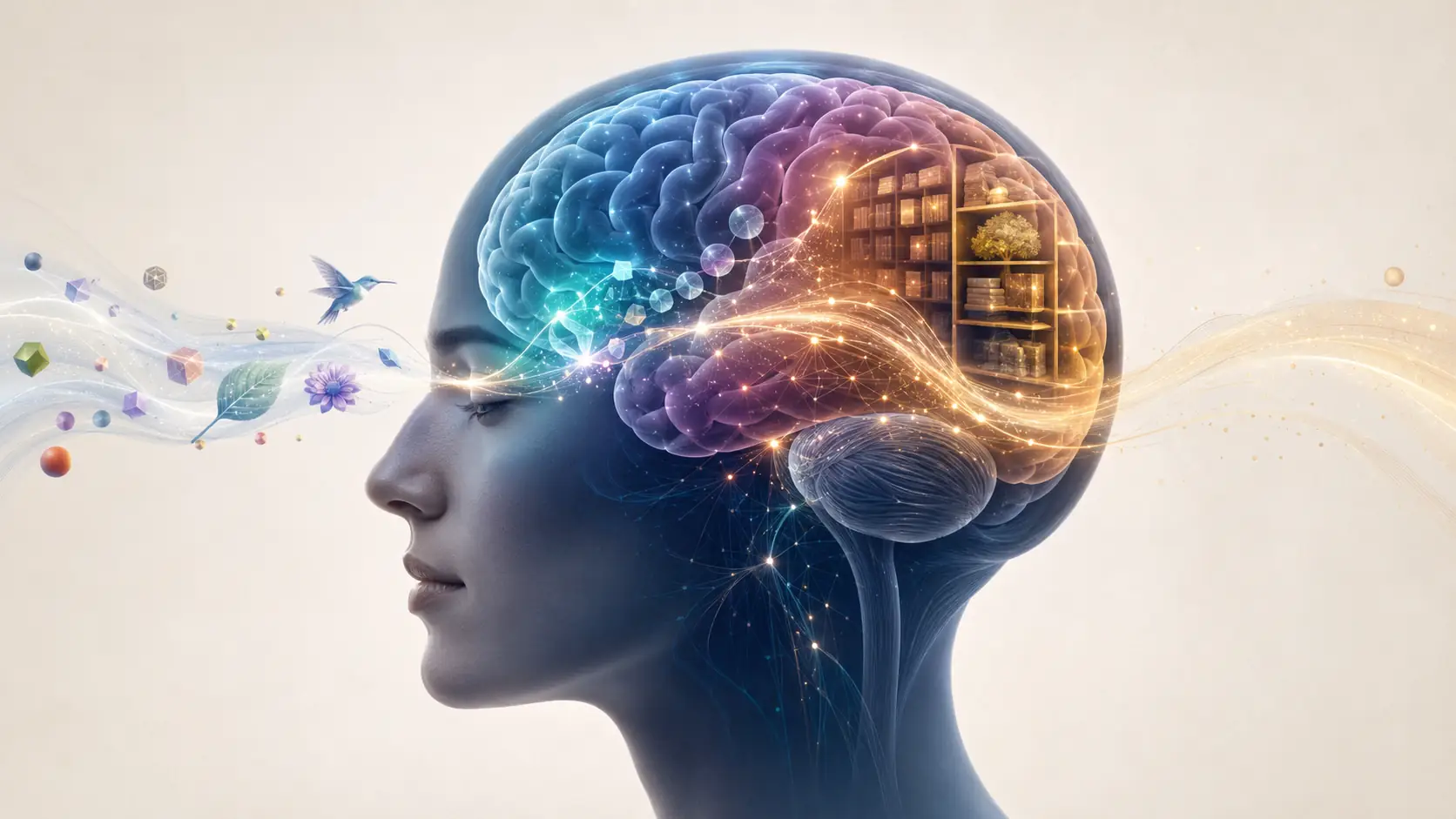
These systems do not operate as completely separate boxes. Some psychological models describe three main stages, while others distinguish working memory from short-term memory and divide long-term memory into additional subtypes.
Memory is commonly discussed as four broad types: sensory, short-term, working and long-term memory. However, there is no single list accepted for every purpose. Some psychological models describe three main stages, while others separate working memory from short-term memory or divide long-term memory into several additional types.
This guide explains those classifications, how the different types of memory relate to one another and why sources sometimes give different answers to the same question.
What Are the Main Types of Memory?
Memory is commonly discussed as four broad types: sensory, short-term, working and long-term memory. These systems help you briefly notice information, hold it in mind, use it and store it for later. Long-term memory is then divided into subtypes, including episodic, semantic and procedural memory.
| Type of memory | What it does | Typical duration and capacity | Everyday example |
|---|---|---|---|
| Sensory memory | Briefly holds information received through sight, sound, touch and the other senses | Lasts from milliseconds to a few seconds. It briefly registers a large amount of information, but most of it quickly fades. | Still seeing the trace of an image for a moment after looking away |
| Short-term memory | Temporarily holds a small amount of information without necessarily using it | Usually lasts for seconds without rehearsal and can hold only a few meaningful chunks. | Holding a phone number in mind before entering it |
| Working memory | Holds and actively uses, updates or reorganises information during a mental task | Lasts for as long as the information is being actively used. Its capacity is limited and depends on the task. | Remembering numbers while completing a mental calculation |
| Long-term memory | Stores knowledge, experiences and learned skills for later use | Can last from minutes to an entire lifetime and has no established fixed capacity. | Remembering a childhood event, a historical fact or how to ride a bicycle |
These types of memory do not operate as completely separate boxes. Sensory memory briefly registers what you see, hear and feel. Information that receives your attention may enter short-term memory, while working memory allows you to use that information in the moment. Some of it may then be stored in long-term memory for later retrieval.
Short-term and working memory overlap, but they are not identical. Short-term memory mainly holds information, whereas working memory allows you to use, update or reorganise it. Some psychological models treat working memory as part of short-term memory, while others describe it as a separate system. Our guide to working memory versus short-term memory explains this distinction in more detail.
What Are the Main Types of Long-Term Memory?
Long-term memory can be divided into explicit and implicit memory. Explicit memory involves information you can consciously bring to mind, while implicit memory affects your knowledge and behaviour without deliberate recollection.
| Long-term memory subtype | Category | What it stores | Everyday example |
| Episodic memory | Explicit or declarative memory | Personal events and experiences connected to a particular time or place | Remembering your first day at school |
| Semantic memory | Explicit or declarative memory | Facts, meanings, concepts and general knowledge | Knowing that Paris is the capital of France |
| Procedural memory | Implicit or non-declarative memory | Learned skills and actions that can become automatic | Knowing how to ride a bicycle |
Episodic and semantic memory both involve conscious recall, but they store different kinds of information. Episodic memory allows you to mentally revisit an experience, while semantic memory gives you access to facts and knowledge without needing to remember when you learned them. Procedural memory works differently: once a skill becomes familiar, you can often perform it without consciously recalling each individual step.
Why Do Some Sources Say There Are Three, Four or Eight Types of Memory?
Different answers usually come from different ways of organising the same underlying processes.
The traditional three-stage model describes:
-
sensory memory
-
short-term memory
-
long-term memory
A four-type explanation separates working memory from short-term memory because holding information and actively manipulating it are not quite the same operation.
Longer lists often combine these broad systems with their subtypes. An article describing eight types, for example, might list sensory, short-term, working, long-term, episodic, semantic, procedural and prospective memory. That can be useful for introducing the terms, but the categories do not all sit at the same level. Episodic, semantic and procedural memory are forms of long-term memory, while prospective memory describes remembering to carry out a future intention.
It is therefore more accurate to think of memory as a hierarchy than a flat list:
-
Sensory memory
-
Short-term memory
-
Working memory — treated as part of short-term memory in some models and as a related system in others
-
Long-term memory
-
Explicit memory
-
Episodic memory
-
Semantic memory
-
-
Implicit memory
-
Procedural memory
-
Priming and other learned effects
-
-
-
Other functional descriptions, including prospective, autobiographical and spatial memory
The number depends on whether a source is describing stages, storage systems, conscious awareness, the kind of information being remembered or the purpose the memory serves.
Sensory Memory: Registering Information for an Instant
Sensory memory is the first and briefest stage of memory. It retains a trace of sensory information after the original sight, sound or sensation has disappeared.
Most sensory information fades before you consciously notice it. Attention helps select a small part of that stream for further processing. Without this brief sensory record, experience would feel less continuous: sounds would end abruptly, movement would appear disconnected and each new sight would immediately replace the one before it.
Sensory memory is often divided according to the sense involved:
| Sensory-memory type | Sense | Simple example |
| Iconic memory | Vision | Briefly retaining the appearance of a light or image after looking away |
| Echoic memory | Hearing | Holding the last few words of a sentence long enough to make sense of it |
| Haptic memory | Touch | Briefly remembering the pressure or texture of something you just touched |
Researchers also study sensory traces connected to smell and taste, although iconic and echoic memory have received the most attention in classic memory research.
Sensory memory is not the same as carefully remembering a sight or sound later. If you recall a song from childhood or picture your old school, you are retrieving information from long-term memory rather than sensory memory.
Short-Term Memory: Holding Information Briefly
Short-term memory temporarily keeps a limited amount of information available. You use it when you remember a verification code long enough to type it, hold the end of a sentence in mind or recall where you just placed an object.
Without rehearsal or another reason to retain it, this information usually fades within seconds. Repeating a number, grouping information into meaningful chunks or connecting it with knowledge you already have can keep it available for longer and may help it become part of long-term memory.
Short-term memory has a limited capacity. The exact number varies with the task, the information and how it is grouped, but modern research generally suggests that people can hold only a few separate items or chunks at once.
This limit explains why the following sequence is difficult to remember:
1 4 9 2 1 7 7 6 1 9 4 5
Grouping it into familiar dates makes the same information easier to hold:
1492 — 1776 — 1945
The digits have not changed. What changes is the number of meaningful units your short-term memory needs to manage.
Working Memory: Holding and Using Information
Working memory is the mental workspace you use to hold information while doing something with it. It supports reading comprehension, reasoning, decision-making, mental arithmetic and following multi-step instructions.
For example, calculating 27 + 48 in your head requires you to hold the original numbers, remember an intermediate answer and update it as you continue. Short-term storage keeps the information available; working memory lets you manipulate it.
Working memory is closely related to attention and executive control. It becomes harder to use when a task is unfamiliar, distractions compete for attention or too many steps must be held in mind at once.
For a closer look at this mental workspace, our guide to what working memory is explores everyday examples, its main components and the factors that can affect it.
Long-Term Memory: Retaining Experiences, Knowledge and Skills
Long-term memory allows information to remain available beyond the immediate task. It includes something you learned earlier in the day, a skill developed over several years and events remembered from childhood.
Long-term memory does not act like a perfect recording. What you remember depends on how information was encoded, how it relates to existing knowledge and which cues are available when you try to retrieve it. Memories can also be updated, reorganised or distorted over time.
Long-term memory is commonly divided according to whether recall is conscious.
Explicit or Declarative Memory
Explicit memory contains information you can consciously describe or bring to mind. It includes episodic and semantic memory.
Episodic Memory
Episodic memory is memory for personally experienced events. It usually contains information about what happened, where it occurred, when it took place and how the experience felt.
Examples include remembering:
-
a conversation from yesterday
-
your first day in a new job
-
where you parked the car
-
what happened during a recent holiday
Episodic memory is closely connected to autobiographical memory, although autobiographical memory can also contain facts about your life that you simply know rather than vividly re-experience.
Semantic Memory
Semantic memory contains facts, meanings, concepts and general knowledge. You may know the information without remembering when or where you learned it.
Examples include knowing:
-
the meaning of a word
-
the capital of a country
-
how many days are in a week
-
what a bicycle is used for
You may remember learning a fact at first, but over time the knowledge can remain even after the original learning experience has faded.
Implicit or Non-Declarative Memory
Implicit memory influences behaviour without requiring deliberate conscious recall. It includes learned skills, habits, priming and some forms of conditioning.
Procedural Memory
Procedural memory supports learned actions and skills. Once a skill becomes familiar, you can often perform it without verbally recalling every step.
Examples include:
-
riding a bicycle
-
tying shoelaces
-
typing on a familiar keyboard
-
playing a well-practised musical scale
Knowing how to ride a bicycle is therefore different from knowing a fact about bicycles. The first relies strongly on procedural memory; the second is semantic knowledge.
Other Types of Memory You May See Mentioned
Not every useful memory term fits neatly into the sensory, short-term, working and long-term structure. Some terms describe what is remembered or the job the memory performs.
Prospective Memory
Prospective memory is remembering to perform an intended action in the future. It is sometimes described as “remembering to remember.”
It can be:
-
time-based, such as remembering to take medicine at 8pm
-
event-based, such as remembering to give someone a message when you see them
Prospective memory draws on attention, working memory and previously stored intentions, so it should not be treated as a separate storage box alongside short-term or long-term memory.
Autobiographical Memory
Autobiographical memory contains information about your own life. It can combine episodic memories of particular experiences with semantic facts about yourself, such as where you grew up or which school you attended.
Spatial Memory
Spatial memory helps you remember locations, routes and the relationships between objects in space. You use it when navigating through a familiar building, recalling where an item is kept or picturing the layout of a room.
Emotional and Flashbulb Memory
Emotion can make an event feel particularly vivid or important. The term flashbulb memory describes a detailed recollection of the circumstances in which someone learned about a surprising or emotionally significant event.
Vividness does not guarantee perfect accuracy. A memory may feel exceptionally clear while some details have changed or become less reliable over time.
Is Photographic Memory a Type of Memory?
“Photographic memory” is a popular term for the supposed ability to store and reproduce an image with camera-like accuracy. It is not recognised as one of the main memory systems used in psychology.
The closest research term is eidetic imagery: the ability to retain an unusually vivid visual image for a short period after the original image has disappeared. Eidetic imagery is considered rare, is reported more often in children and is not necessarily permanent or perfectly accurate.
People can have exceptional visual, autobiographical or factual memory without possessing a literal mental photograph. Memory champions also tend to rely on learned strategies such as visual association and the memory-palace method rather than an automatic camera-like record.
It is therefore more accurate to describe photographic memory as a popular idea related to exceptional visual recall, not as another category equal to sensory, working or long-term memory.
Where Are Different Types of Memory Processed in the Brain?
Memory is produced by networks of brain regions rather than one single “memory centre.” Different regions make particularly important contributions to different forms of memory, but they usually work together.
| Brain region or network | Important memory role |
| Hippocampus and surrounding medial-temporal regions | Important for forming and organising new episodic and declarative memories |
| Prefrontal cortex | Supports working memory, attention, planning and the organisation of retrieval |
| Amygdala | Helps emotional significance influence learning and memory |
| Basal ganglia | Contributes to habits, skill learning and other procedural processes |
| Cerebellum | Supports motor learning and some conditioned responses |
| Sensory and association cortices | Help represent the sights, sounds, meanings and other features that make up a memory |
These relationships are not one-to-one. Episodic memory, for example, does not exist only inside the hippocampus. Remembering an event can involve the hippocampus alongside frontal, parietal, sensory and other regions distributed across the brain. This is why neurobiological reviews of memory describe interacting systems rather than a single storage location.
How Do the Different Types of Memory Work Together?
Imagine being introduced to someone called Priya at a conference.
-
Sensory memory briefly registers the sound of the name and the person’s appearance.
-
Attention selects the introduction for further processing.
-
Short-term memory holds the name for the next few seconds.
-
Working memory connects “Priya” with what she says about her job and where you met.
-
Episodic memory may retain the experience of the conversation.
-
Semantic memory may store facts you learned about her.
-
Prospective memory may help you remember to send her an email the following day.
This is why everyday remembering rarely depends on only one type of memory. The systems interact, and a problem at one stage can affect what becomes available later. If you were distracted during the introduction, for example, the name may never have been encoded strongly enough to retrieve.
Will Scientific Understanding of Memory Change?
Almost certainly. Memory classifications are scientific models: useful ways of organising current evidence, not permanent labels carved into separate parts of the brain. Reviews of short-term, working and long-term memory show that even familiar categories depend on how researchers define storage, processing and capacity.
Researchers continue to debate where short-term memory ends and working memory begins, how memories become less dependent on the hippocampus over time and how multiple brain networks combine during learning and recall. New imaging methods, experimental techniques and long-term studies may reveal distinctions that current models miss or show that some apparently separate forms of memory rely on more shared processes than previously thought.
That does not make today’s classifications unhelpful. Sensory, short-term, working and long-term memory remain useful ways to explain major differences in duration, capacity and function. The important point is that science remains open to refining those models as stronger evidence becomes available.
Frequently Asked Questions
What are the four main types of memory?
The four broad types commonly discussed are sensory, short-term, working and long-term memory. Some models combine short-term and working memory, which is why other sources describe three main types.
What are the three types of memory in psychology?
The traditional three-stage model consists of sensory memory, short-term memory and long-term memory. Working memory may be treated as part of short-term memory or discussed as a related fourth system.
Are there eight types of memory?
There is no single universally accepted list of eight equal memory types. Lists of eight often combine broad systems with long-term subtypes and functional descriptions, such as episodic, semantic, procedural and prospective memory.
Is working memory the same as short-term memory?
No, although they overlap. Short-term memory briefly holds information. Working memory holds information while actively using, updating or reorganising it.
Is photographic memory a recognised type of memory?
Photographic memory is not considered one of the main psychological memory systems. Eidetic imagery is a related research concept involving unusually vivid short-lived visual recall, but it is rare and not necessarily perfectly accurate.
Which type of memory stores facts?
Semantic memory stores facts, meanings and general knowledge. It is a form of explicit long-term memory.
Which type of memory stores personal experiences?
Episodic memory stores personally experienced events connected to a time, place and context. It is another form of explicit long-term memory.
Which type of memory helps you remember future tasks?
Prospective memory helps you remember intended future actions, such as attending an appointment or sending a message later.
Which type of memory allows you to have meaningful conversations?
Echoic memory briefly holds what you have just heard, helping you make sense of someone’s words and respond. Working memory and your knowledge of language also help you follow the conversation.
Final Takeaway
Memory is best understood as a collection of interacting systems rather than one single store. Sensory memory briefly registers information, short-term memory holds a small amount, working memory uses it and long-term memory retains knowledge, experiences and skills.
Within long-term memory, episodic memory stores experiences, semantic memory stores knowledge and procedural memory supports learned skills. Other terms, including prospective, autobiographical and spatial memory, describe particular kinds of information or jobs that memory performs.
The classifications may continue to evolve as memory science advances, but they provide a practical map of how remembering works today. If you want to move from understanding memory to supporting it, explore our guide to science-backed ways to improve memory.
References
-
Raslau FD, Klein AP, Ulmer JL, Mathews V, Mark LP. Memory Part 1: Overview. American Journal of Neuroradiology. 2014.
-
Cowan N. What are the differences between long-term, short-term, and working memory?. Progress in Brain Research. 2008.
-
Cowan N. The magical number 4 in short-term memory. Behavioral and Brain Sciences. 2001.
-
Baddeley A. Working memory: theories, models, and controversies. Annual Review of Psychology. 2012.
-
Mujawar S, Patil J, Chaudhury S, Saldanha D. Memory: Neurobiological mechanisms and assessment. Industrial Psychiatry Journal. 2021.
-
UCSF Memory and Aging Center. Patient care: Memory.
-
Román-Caballero R, et al. Time-based and event-based prospective memory. Journal of Clinical Medicine. 2023.
-
Berry BM, et al. The possibility of eidetic memory in a patient report. Cureus. 2023.
-
Brady TF, Konkle T, Alvarez GA, Oliva A. Visual long-term memory has a massive storage capacity for object details. Proceedings of the National Academy of Sciences. 2008.