
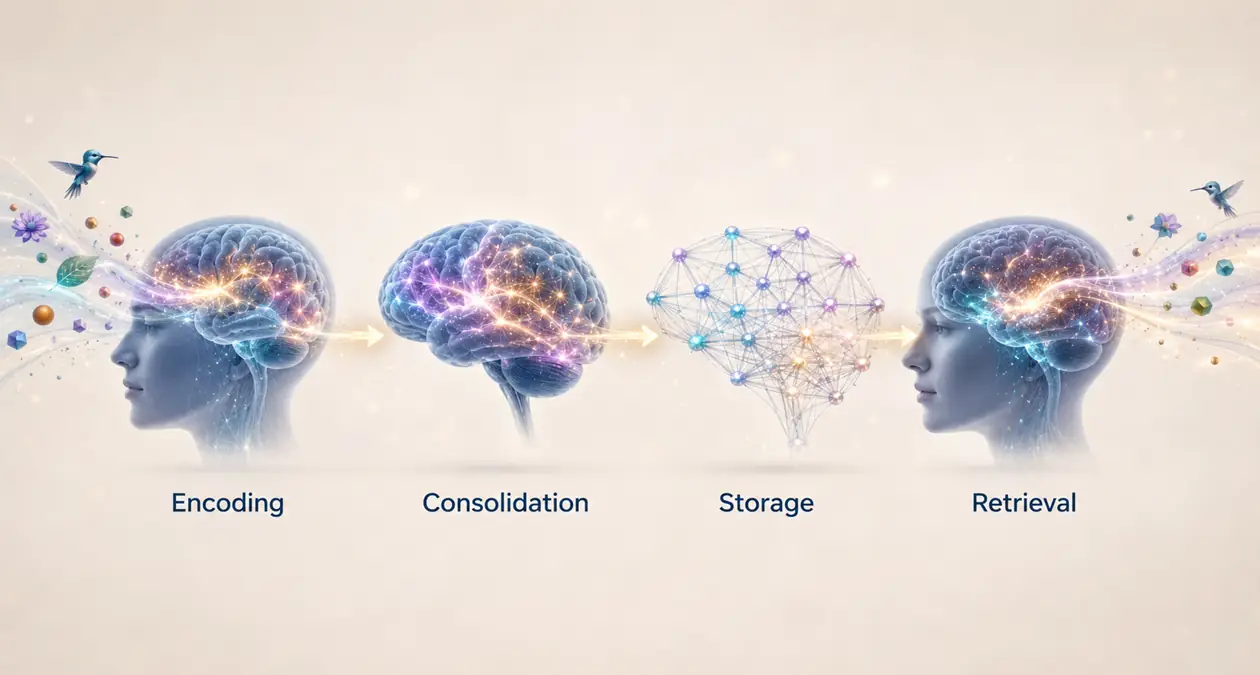
Memories form through encoding, consolidation, storage and retrieval. Learn how the brain turns experiences into memories and recalls them later.
When you experience something, patterns of activity occur across networks of brain cells. Attention and interpretation shape which parts of that experience are encoded. Changes within and between those networks can then stabilise the resulting memory, allowing parts of the original pattern to be reactivated later.
Memory is therefore not like recording a video and saving it in one folder. It is a selective, distributed and continually changing process. What you notice, what the experience means, what happens afterwards and which cues are available later can all affect what you remember.
How Are Memories Formed?
A memory begins when the brain represents an experience through a process called encoding. The new memory is initially vulnerable to disruption, but consolidation can make it more stable and integrate it with existing knowledge. Storage describes the continued retention of that information across changing neural networks. During retrieval, a cue helps reactivate enough of the stored pattern for the memory to influence thought or behaviour.
| Stage | What happens | Everyday example |
|---|---|---|
| Encoding | The brain selects and represents parts of an experience | Noticing that you parked beside the blue stairwell on level three |
| Consolidation | The new representation becomes more stable and connected with existing knowledge | The location remains available after you leave the car park and focus on something else |
| Storage | The memory persists across networks of neurons over time | The parking location is still represented when you return several hours later |
| Retrieval | A cue reactivates information from the stored representation | Seeing the blue-stairwell sign helps you remember where to walk |
Psychology textbooks often simplify this into three processes: encoding, storage and retrieval. Neuroscience discussions frequently describe consolidation separately because stabilising a new memory is not the same as retaining an already established one. These are useful descriptions rather than four sealed compartments; the processes overlap and can continue to influence one another.
1. Encoding: Turning an Experience Into a Memory
Encoding is the initial processing that allows an experience to be represented in memory. Your senses continuously provide more information than you could retain. The brain must select, interpret and connect parts of that information rather than preserve every detail.
Imagine talking to a colleague in a busy café. Your brain is processing the person’s words, facial expressions, background conversations, music, smells and your own thoughts at the same time. You may later remember the main point of the conversation but not the song playing nearby. Both were present, but they did not receive the same processing.
Attention Influences What Is Encoded
Attention is especially important when you want to form a conscious memory for facts or events. Focusing on something gives the brain a better opportunity to represent its details and connect them into a coherent experience. Research on divided attention has repeatedly found that performing another demanding task during learning can reduce later memory.
This is why looking at information is not the same as encoding it well. You can read an entire page while thinking about something else and retain very little of its meaning. The page reached your eyes, but its ideas may not have received enough focused processing to form a reliable memory.
Attention is not an absolute on-off gate. A striking sound, emotional event or familiar pattern can affect memory without deliberate study. However, for everyday learning, divided attention generally produces a weaker and less complete starting representation.
Meaning Creates Connections
Encoding becomes more effective when new information is understood and related to knowledge already in memory. Classic depth-of-processing experiments found better later retention when people processed a word’s meaning rather than only its visual or sound-based features. Thinking about the meaning of a concept, explaining it in your own words or connecting it with a relevant example gives the information more associations that may later support retrieval.
Consider the term consolidation. Repeating its spelling may help you hold the word briefly. Understanding it as “the process that helps a new memory become more stable” gives it meaning. Connecting that definition with the idea that sleep can support newly learned information adds another route back to it.
Researchers sometimes distinguish between:
- Visual encoding, involving features such as shape, colour and location
- Acoustic encoding, involving sounds, voices and speech patterns
- Semantic encoding, involving meaning, concepts and relationships
These are not mutually exclusive systems. A single event can be represented through its sights, sounds, meaning, emotional significance and relationship to other experiences. The combination depends on the material, the task and what matters to you at the time.
2. Consolidation: Stabilising a New Memory
Newly encoded memories are not instantly permanent. Consolidation describes changes that make a memory more stable after learning and help integrate it with existing knowledge.
Scientists discuss consolidation at two related levels.
Synaptic Consolidation
Synaptic consolidation involves changes within local networks during the minutes and hours after learning. Neurons communicate at junctions called synapses. Activity can alter how effectively particular synapses transmit signals, a property known as synaptic plasticity.
Long-term potentiation, or LTP, is one extensively studied form of lasting increase in synaptic strength. It is considered an important candidate mechanism for learning and memory, but it should not be treated as a complete explanation of a human memory. An event is represented by coordinated activity across many cells and brain areas, involving molecular, cellular and network-level changes.
The important practical idea is simple: a new memory continues changing after the original experience has ended. It is not fully fixed at the instant of learning.
Systems Consolidation
Systems consolidation refers to a longer reorganisation of the brain networks supporting a memory. The hippocampus and nearby medial-temporal structures are particularly important for binding together the people, places, timing and other elements of a new event. Over time, repeated reactivation can help integrate parts of that representation across cortical networks.
This is sometimes described as the hippocampus transferring a memory to the cortex. That metaphor is useful but incomplete. A memory is not moved intact from one storage location to another. Its representation can be reorganised, connected with previous knowledge and transformed as the networks supporting it change.
Researchers also disagree about whether richly detailed episodic memories ever become completely independent of the hippocampus. The standard model of systems consolidation and theories proposing a continuing hippocampal role explain some findings differently. It is safer to say that hippocampal–cortical interactions change over time than to claim that every memory follows one fixed transfer route.
What Role Does Sleep Play?
Sleep provides conditions that can support memory consolidation. During sleep, patterns related to recent learning may be reactivated, and coordinated activity between the hippocampus and cortex is thought to help stabilise and reorganise some memories. A major review of sleep and memory describes sleep as a brain state that is particularly well suited to consolidation.
Sleep does not automatically preserve everything encountered during the day, and consolidation does not happen only while asleep. Reactivation and change can also occur during quiet wakefulness. The effect of sleep varies with the type of memory, the stage of sleep, the learning conditions and the person.
The balanced conclusion is that sleep supports memory formation; it is not a switch that turns every experience into a permanent memory. NeuroLifts’ guide to optimising sleep for memory covers practical sleep habits in more detail.
3. Storage: How the Brain Retains a Memory
Storage means that the changes supporting a memory continue to exist over time. It does not mean that the brain keeps a complete copy of an experience in one physical location.
The sight of a friend, the sound of their voice, the meaning of what they said and the feeling associated with the conversation involve activity across different neural systems. Remembering the conversation later requires enough of this distributed pattern to be reconstructed.
Researchers use the word engram to describe the physical and biological changes that support a particular memory. Modern engram research suggests that memories involve groups of connected neurons distributed across brain regions. Cells involved during learning can be reactivated during later retrieval, and changing their activity can affect memory behaviour in laboratory studies.
Much of the most precise causal engram research has been carried out in animals because researchers can label and manipulate selected cells in ways that are not possible in healthy humans. Human imaging and clinical evidence also support distributed memory networks, but scientists cannot yet observe the complete physical representation of a personal memory cell by cell.
Memories Are Stored Across Networks, Not in One Memory Centre
Different regions make different contributions:
- The hippocampus helps bind elements of new events and supports the formation and retrieval of episodic and declarative memories.
- The cerebral cortex represents sensory details, meanings and knowledge across widely distributed areas.
- The prefrontal cortex supports attention, organisation, working memory and strategic retrieval.
- The amygdala helps emotional significance influence learning and consolidation; it does not store every emotional memory by itself.
- The basal ganglia and cerebellum contribute to habits, skills and forms of motor learning.
These regions work as networks rather than isolated storage units. Their involvement also depends on whether you are remembering an event, using factual knowledge or performing a learned skill. Our guide to the different types of memory explains those memory systems and their relationships without repeating the formation process covered here.
Stored Does Not Mean Unchanged
Memories can become less detailed, more general or more closely connected with related knowledge over time. New experiences can interfere with older ones, while repeated use can strengthen some parts of a memory and leave others less accessible.
A strong memory is also not necessarily a perfectly accurate memory. Confidence and vividness describe how remembering feels; they do not guarantee that every reconstructed detail matches the original event.
4. Retrieval: Bringing a Memory Back
Retrieval is the process through which stored information becomes available again. A cue—such as a question, location, smell, image or thought—helps reactivate parts of the neural pattern associated with an earlier experience.
Retrieval can take several forms:
- Free recall: producing information without being given the answer, such as describing what happened at a meeting
- Cued recall: retrieving information after a prompt, such as remembering a name when given its first letter
- Recognition: identifying something encountered before, such as selecting the correct name from a list
- Implicit expression: showing the influence of previous experience without deliberately recalling it, as when a well-practised action becomes easier to perform
Recognition often feels easier than recall because the item itself provides a strong cue. This helps explain why rereading can create a sense of familiarity even when you cannot produce the information independently.
Retrieval Depends on the Available Cues
A memory may be stored but temporarily difficult to access. Retrieval is often more successful when the cues available now overlap with the way the information was encoded. A review of the neurobiology of retrieval describes access as an interaction between retrieval cues and the neural ensembles supporting a memory.
For example, you might be unable to remember an actor’s name during a conversation, then recall it when you see a picture from a particular film. The picture supplies context that the original question did not.
This does not mean that every forgotten detail remains permanently stored and only needs the perfect cue. A memory may have been weakly encoded, altered, interfered with or lost. The point is that failure to retrieve information at one moment does not by itself reveal exactly what happened to the memory.
Retrieval Can Strengthen and Update Memory
Remembering is not only the final output of memory. Retrieval can make information easier to access again, which helps explain why testing yourself can improve long-term learning. In a well-known study, retrieving previously studied material improved later retention more than repeatedly studying it for the same period.
Retrieval can also make a memory open to change under some conditions. It may then be restabilised through a process called reconsolidation, potentially incorporating new information. Reconsolidation is an active research area and does not mean that every act of remembering automatically rewrites an entire memory.
For a step-by-step study method built around this principle, see NeuroLifts’ guide to active recall.
What Happens in the Brain When a Memory Forms?
At the simplest useful level, an experience activates a particular combination of neurons. Connections within the relevant networks change, making aspects of that pattern more likely to be reactivated in the future.
The process involves several levels at once:
- Neural activity represents the experience. Sensory, emotional and conceptual features produce patterns of activity across the brain.
- Attention and interpretation select relationships. The brain does not retain every input equally; it prioritises and binds information according to the task and context.
- Synapses and cells change. Activity-dependent plasticity alters how neurons respond and communicate.
- Networks reactivate and reorganise. During later wakefulness and sleep, reactivation can help stabilise and integrate the memory.
- A later cue partially reinstates the pattern. Retrieval reconstructs the memory from the information and connections that remain available.
This explanation is more accurate than saying that one brain cell contains one memory or that the hippocampus saves an experience like a computer file. A single neuron can participate in more than one representation, and a single memory can involve cells across several regions.
An Everyday Example of Memory Formation
Suppose you park in an unfamiliar multi-storey car park before an appointment.
During Encoding
You notice that the car is on level three beside a blue stairwell. If you are reading a message while walking away, those details may receive little attention and be poorly encoded.
During Consolidation
The new representation begins to stabilise after you leave. It may become connected with existing knowledge, such as your understanding of the building’s layout or the phrase “blue on three.” The memory can continue to change while you attend the appointment and during later rest.
During Storage
Features of the event persist across a distributed representation: the visual colour, the level number, the spatial route and the fact that this is where you parked today. They are not necessarily stored as one perfectly complete scene.
During Retrieval
When you return, the lift buttons, the sight of the stairwell or the question “Where did I leave the car?” act as cues. If the cues reactivate enough of the earlier representation, you remember the location. If you encoded only “near the stairs” and there are several stairwells, retrieval may remain uncertain.
The example shows why remembering is influenced by the entire process. A failure in the car park may feel like a retrieval problem later even though the main weakness occurred during encoding.
Why Do Some Experiences Form Stronger Memories?
No single factor determines what will last, but several conditions can influence memory formation.
| Factor | How it can affect memory formation |
|---|---|
| Focused processing | Undivided attention gives relevant details a better opportunity to be encoded; multitasking can create an incomplete starting representation. |
| Meaning and prior knowledge | Understanding new information and connecting it with something you already know creates structure and additional retrieval routes. |
| Distinctiveness and emotion | Unusual or important events may receive extra processing, although emotional vividness and confidence do not guarantee accurate detail. |
| Reactivation and retrieval | Bringing information to mind can strengthen later access instead of merely measuring what you know. |
| Spacing | Returning after delays creates repeated opportunities for encoding, consolidation and retrieval. The spaced-repetition guide explains how to schedule reviews. |
| Sleep and recovery | Sleep supports attention for new learning as well as later consolidation, so poor sleep can affect more than one stage. |
Where Can Memory Formation Break Down?
“I forgot” can describe several different events.
| What went wrong | What it may feel like | Example |
|---|---|---|
| Weak encoding | “It disappeared immediately” | You heard the introduction while checking your phone and never clearly learned the name |
| Disrupted consolidation or interference | “I knew it yesterday, but it did not stick” | Several similar pieces of information became confused after one crowded study session |
| Change during storage | “I remember the outline, but not the details” | The general meaning remains while precise wording fades |
| Retrieval difficulty | “I know it, but I cannot bring it to mind” | A word returns later when the pressure has passed or a better cue appears |
These possibilities cannot always be separated from everyday experience alone. A missed answer does not prove that a memory was never stored, and later recognition does not prove that the original memory remained unchanged.
The dedicated guide Why do I forget things so easily? explores common causes and practical responses. Sudden, worsening or disruptive memory problems require individual medical assessment rather than an explanation from a general article.
Does Remembering Change a Memory?
Remembering is reconstructive. The brain does not simply play back an untouched recording; it rebuilds an account using stored information, current cues, existing knowledge and the present context.
This flexibility is useful. It allows memories to be updated when circumstances change and helps extract general knowledge from repeated experiences. It also creates room for omissions, blending and error.
When a memory is reactivated, it can sometimes become temporarily more modifiable before it stabilises again. Scientists call this reconsolidation. Research supports reconsolidation in several forms of learning, but the conditions that trigger it differ across memories and experiments. It would be too strong to claim that every retrieval completely rewrites the past.
The practical lesson is not to distrust every memory. It is to distinguish confidence from accuracy and recognise that memory is designed to guide present behaviour, not to preserve a flawless archive.
What Scientists Still Do Not Know About Memory Formation
The broad account of encoding, consolidation, storage and retrieval is well established, but important questions remain open.
Researchers continue to investigate:
- How stable or flexible particular engram networks remain over long periods
- When a detailed episodic memory continues to depend on the hippocampus
- How sleep and quiet wakefulness select which recent experiences to strengthen
- Why retrieval destabilises some memories but not others
- How neural, immune, hormonal and support-cell processes interact during memory formation
- How findings from controlled animal studies translate to complex autobiographical memory in humans
Memory science is therefore evolving. New methods may refine the models used in this article, but that does not make the current framework unhelpful. Encoding, consolidation, storage and retrieval remain a practical way to understand why an experience may be noticed, retained, recalled, changed or forgotten.
The practical implication is to support the whole process: protect attention during encoding, connect new information with meaning, allow time and sleep for consolidation, retrieve without looking and repeat that retrieval across time. The NeuroLifts guide to science-backed ways to improve memory brings those methods together without expanding this explanation into a second improvement guide.
Frequently Asked Questions
What Are the Three Main Processes of Memory?
The three processes commonly taught in psychology are encoding, storage and retrieval. Neuroscience explanations often discuss consolidation separately because stabilising and reorganising a new memory is distinct from its continued storage.
How Long Does It Take to Form a Memory?
There is no single moment when every memory becomes complete. Encoding can begin within fractions of a second, while synaptic consolidation unfolds over minutes and hours. Reorganisation across brain systems can continue for days, months or longer, depending on the memory and how it is used.
Where Are Memories Formed in the Brain?
Memories form through networks distributed across the brain. The hippocampus is particularly important for binding the elements of new episodic and declarative memories, while cortical regions represent sensory and conceptual details. Other systems contribute to emotion, habits, skills and strategic retrieval.
Are Memories Stored in the Hippocampus?
Not as complete files. The hippocampus helps organise and bind new experiences and can remain involved when episodic memories are retrieved. Long-term representations also depend on distributed cortical and other neural networks.
Does Sleep Create Memories?
Encoding begins while you are awake and experiencing or learning something. Sleep can support the later consolidation and reorganisation of some memories, but it does not preserve everything automatically and is not the only time consolidation occurs.
Why Do We Not Remember Everything We Experience?
Attention and memory are selective. Much of the information reaching your senses receives little processing, and even encoded information can weaken, change or become difficult to retrieve. Remembering everything would not necessarily be useful; memory prioritises information relevant to learning and behaviour.
Can Recalling a Memory Change It?
Yes. Retrieval can strengthen, update or sometimes distort a memory. Under certain conditions, a reactivated memory may become modifiable before being restabilised through reconsolidation. However, not every act of remembering rewrites the entire memory.
Is Memory Formation the Same for Every Type of Memory?
No. The broad processes apply across memory, but remembering an event, learning a fact and acquiring a motor skill rely on partly different neural systems and timescales. See the guide to types of memory for the complete classification.
Final Takeaway
Memories form through interacting processes rather than one act of storage. Encoding represents selected parts of an experience. Consolidation helps the new representation become more stable and integrated. Storage allows its neural basis to persist, while retrieval reactivates enough of the pattern for the past to influence the present.
The result is not a perfect recording. Memory is selective, distributed and capable of change. That flexibility is part of what allows you to learn, connect new information with previous knowledge and use experience to guide what you do next.
References
- Guskjolen A, Josselyn SA, Frankland PW. Engram neurons: Encoding, consolidation, retrieval, and forgetting of memory. Molecular Psychiatry. 2023.
- Ortega-de San Luis C, Ryan TJ. Understanding the physical basis of memory. Journal of Biological Chemistry. 2022.
- Dudai Y, Karni A, Born J. The consolidation and transformation of memory. Neuron. 2015.
- Squire LR, Genzel L, Wixted JT, Morris RGM. Memory consolidation. Cold Spring Harbor Perspectives in Biology. 2015.
- Josselyn SA, Tonegawa S. Memory engrams: Recalling the past and imagining the future. Science. 2020.
- Takeuchi T, Duszkiewicz AJ, Morris RGM. The synaptic plasticity and memory hypothesis. Philosophical Transactions of the Royal Society B. 2014.
- Rasch B, Born J. About sleep’s role in memory. Physiological Reviews. 2013.
- Staresina BP, Bergmann TO, Bonnefond M, et al. Coupled sleep rhythms for memory consolidation. Nature Reviews Neuroscience. 2024.
- Craik FIM, Govoni R, Naveh-Benjamin M, Anderson ND. The effects of divided attention on encoding and retrieval processes in human memory. Journal of Experimental Psychology: General. 1996.
- Roediger HL III, Karpicke JD. Test-enhanced learning: Taking memory tests improves long-term retention. Psychological Science. 2006.
- Zaki Y, Bhat V, Weber S, et al. Memory engram stability and flexibility. Neuropsychopharmacology. 2024.
- Moscovitch M, Cabeza R, Winocur G, Nadel L. Episodic memory and beyond: The hippocampus and neocortex in transformation. Annual Review of Psychology. 2016.
- Craik FIM, Tulving E. Depth of processing and the retention of words in episodic memory. Journal of Experimental Psychology: General. 1975.
- Frankland PW, Josselyn SA, Köhler S. The neurobiological foundation of memory retrieval. Nature Neuroscience. 2019.
- Phelps EA, Sharot T. How (and why) emotion enhances the subjective sense of recollection. Current Directions in Psychological Science. 2008.