


Episodic memory lets you revisit an event from your life. Semantic memory gives you knowledge without requiring you to revisit the occasion on which you learned it.
You might remember sitting in a classroom when you first heard that Canberra is the capital of Australia. Years later, you can still know the fact even if the classroom, teacher and lesson have disappeared from memory. The event was episodic; the surviving knowledge is semantic.
Both are forms of explicit, long-term memory, and they constantly work together.
What Is the Difference Between Episodic and Semantic Memory?
Episodic memory is memory for personally experienced events situated in a particular context. Semantic memory is knowledge of facts, meanings, concepts and relationships that can be used without recalling a specific learning event.
If you remember getting caught in the rain on your way home last Tuesday, you are using episodic memory. If you know that rain forms when water droplets in clouds become heavy enough to fall, you are using semantic memory.
| Feature | Episodic memory | Semantic memory |
|---|---|---|
| Main content | Particular events and experiences | Facts, meanings, concepts and general knowledge |
| Connection to context | Usually linked to a time, place and situation | Can be accessed without the original learning context |
| Subjective experience | May involve a sense of mentally returning to the event | Usually feels like knowing rather than reliving |
| Personal involvement | The event happened to you or was experienced from your perspective | The knowledge can be personal or shared by many people |
| Typical details | People, actions, sequence, sights, sounds, thoughts and feelings | Names, definitions, categories, rules and relationships |
| Simple example | Remembering your first day in a new job | Knowing what a job interview is |
| Broad neural emphasis | Strongly depends on the hippocampus and a wider event-recollection network | Depends on distributed conceptual networks, including temporal regions; new learning can also involve the hippocampus |
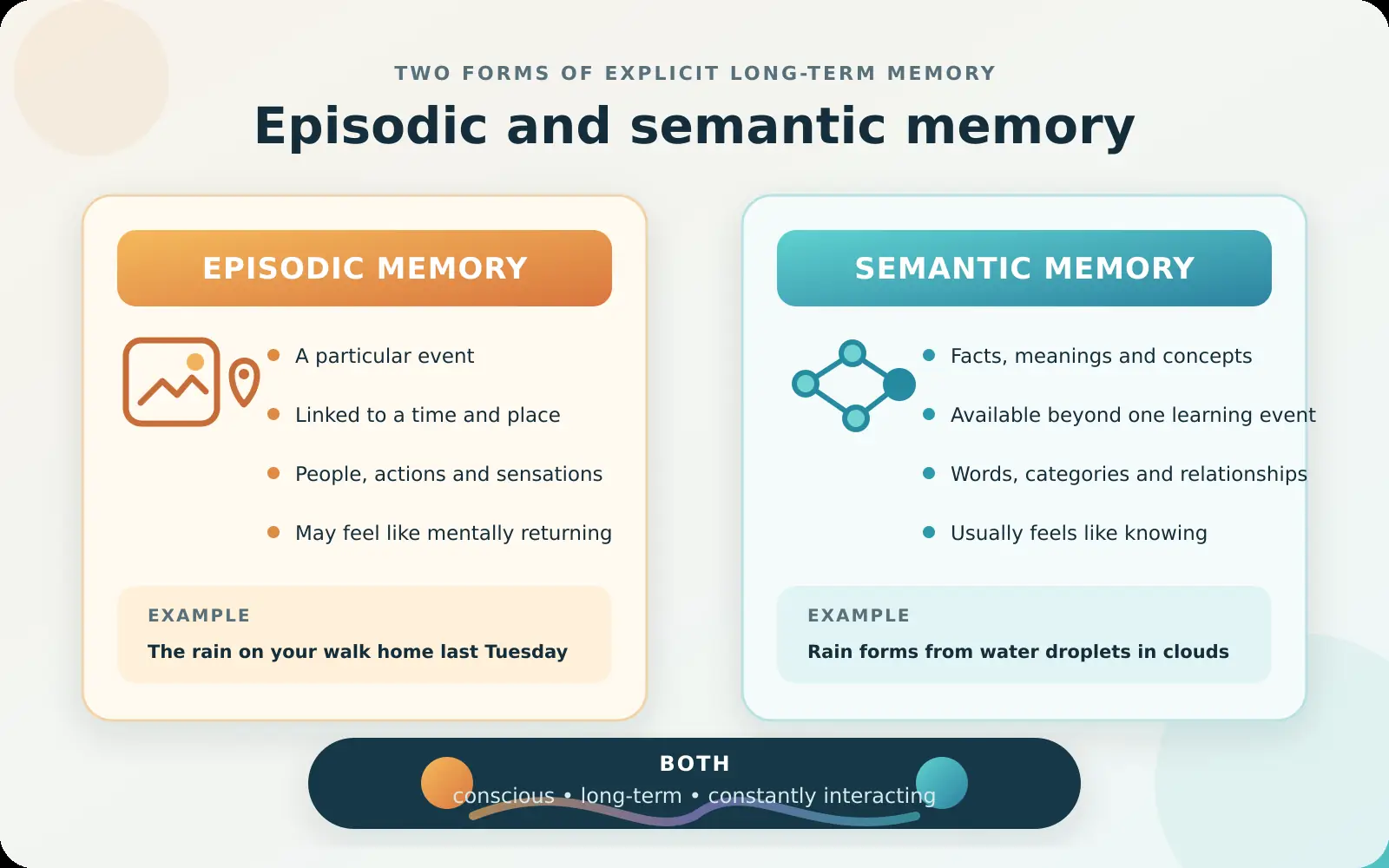
These are tendencies, not a diagnostic checklist for individual memories. A recollection can contain semantic knowledge, and a familiar fact can bring an episode rushing back.
Episodic and semantic memory sit within the explicit or declarative branch of long-term memory. Procedural memory, priming and conditioning belong to a different broad branch and are outside this comparison.
What Is Episodic Memory?
Episodic memory allows you to remember a particular occurrence from your own past. A typical episodic memory binds several elements into one event: what happened, where it happened, roughly when it happened and how it unfolded.
Examples include remembering:
- the joke that made everyone laugh at dinner last night
- where you parked this morning
- your first view of the sea on a holiday
- a difficult conversation and the pause before the other person answered
- which route you took on a run at the weekend
The event does not need to be important or old. Remembering where you placed your glasses a minute ago can be episodic if you retrieve the recent action in context.
What makes episodic memory distinctive is not merely that the content is personal. It is the reconstruction of an event as an event. You may picture the room, hear part of a sentence or recover the order in which things happened. Researchers often describe this as autonoetic awareness: an awareness of yourself in subjective time.
That sense of return can be powerful, but it is not proof that every detail is correct. Episodic remembering is reconstructive. It combines retained information with present cues, expectations and general knowledge. A memory can feel immediate while still omitting, rearranging or misattributing parts of the original experience.
Episodic Memory Is More Than a Story About the Past
The episodic system also helps people construct possible future events. To imagine meeting a friend at a new café next Saturday, you can recombine remembered people, places and actions into a scene that has not happened. In an fMRI study, remembering past events and imagining future ones engaged overlapping regions, including the hippocampus during event construction.
This does not mean every plan is an episodic memory. It shows that a system used to rebuild past experiences can also supply details for simulating what might happen next.
What Is Semantic Memory?
Semantic memory is your store of knowledge about the world, language and concepts. It allows you to understand words, recognise categories, use rules and answer factual questions without searching for the occasion on which each piece of information was learned.
Examples include knowing:
- that a lemon is a fruit
- what the word fragile means
- that 12 multiplied by 12 is 144
- where Japan is on a map
- that a passport is used for international travel
- how bishops move in chess
Calling semantic memory “general knowledge” can make the system sound narrower than it really is. It includes the web of meanings and relationships that makes thought and language possible. Knowing that a Labrador is a dog also brings knowledge about animals, pets, fur, behaviour and countless other connected concepts.
You do not have to remember being taught a fact to use it. In many cases, you cannot. Ask yourself where you learned the meaning of window. There may be no recoverable lesson, yet the concept is readily available.
Semantic Memory Can Be Personal
Not all semantic knowledge is impersonal or culturally shared. You know facts about your own life: the town where you grew up, the name of your primary school, the industry you work in or the fact that you used to play tennis. These are often called personal semantic memories.
They are autobiographical, but they are not necessarily episodic. You may know that you lived on a certain street without being able to relive one specific moment there.
This creates a useful middle ground between a textbook example of a world fact and a richly recalled event. Recent imaging research comparing general facts, autobiographical facts, repeated events and unique events found both substantial neural overlap and graded differences across these forms of memory.
One Weekend, Two Kinds of Memory
Imagine that you visited Lisbon for the first time.
Your memory of stepping off a tram, hearing its bell and realising that you had taken the wrong route is episodic. It belongs to a particular occasion and can be reconstructed as a scene.
Knowing that Lisbon is the capital of Portugal is semantic. You can use that fact without returning to the tram ride—or remembering where you learned it at all.
The same trip may leave both kinds of memory:
| What remains later | Memory type | Why |
|---|---|---|
| The view from a hill as the light changed | Episodic | It is a particular experienced moment with a setting |
| Lisbon is built across several hills | Semantic | It is general knowledge that no longer requires one learning episode |
| You stayed near Rossio Square | Personal semantic | It is a fact about your own past, even if no single scene returns |
| The hotel receptionist drew a route on a paper map | Episodic | It refers to one event and its sequence |
| The Portuguese word obrigado expresses thanks when used by a man | Semantic | It is language knowledge available beyond the occasion on which it was learned |
Real memories do not arrive with labels attached. The point of the distinction is to identify what is being retrieved: an event, knowledge, or a mixture of both.
Episodic Memory Is Not the Same as Autobiographical Memory
The terms are often used as though they mean the same thing, but autobiographical memory is broader. It includes both episodic recollections and semantic knowledge about your life.
Compare these statements:
- “I remember standing beside the school gate on my first morning.”
- “I went to Northfield Primary School.”
The first describes a specific scene and is episodic. The second is a personal fact and can be semantic, even though both concern the same life history.
Researchers can separate these contributions when people tell stories about their past. The Autobiographical Interview, for example, distinguishes event-specific details—such as time, place, perceptions and thoughts—from facts, repetitions and other information not tied to the central episode.
This also explains a familiar conversational experience. Someone asks about your holiday, and you begin with an episode: “On the second morning, we missed the train.” A moment later you add semantic background: “The trains normally run every half-hour.” A natural account moves between both without announcing the switch.
Does Episodic Memory Turn Into Semantic Memory?
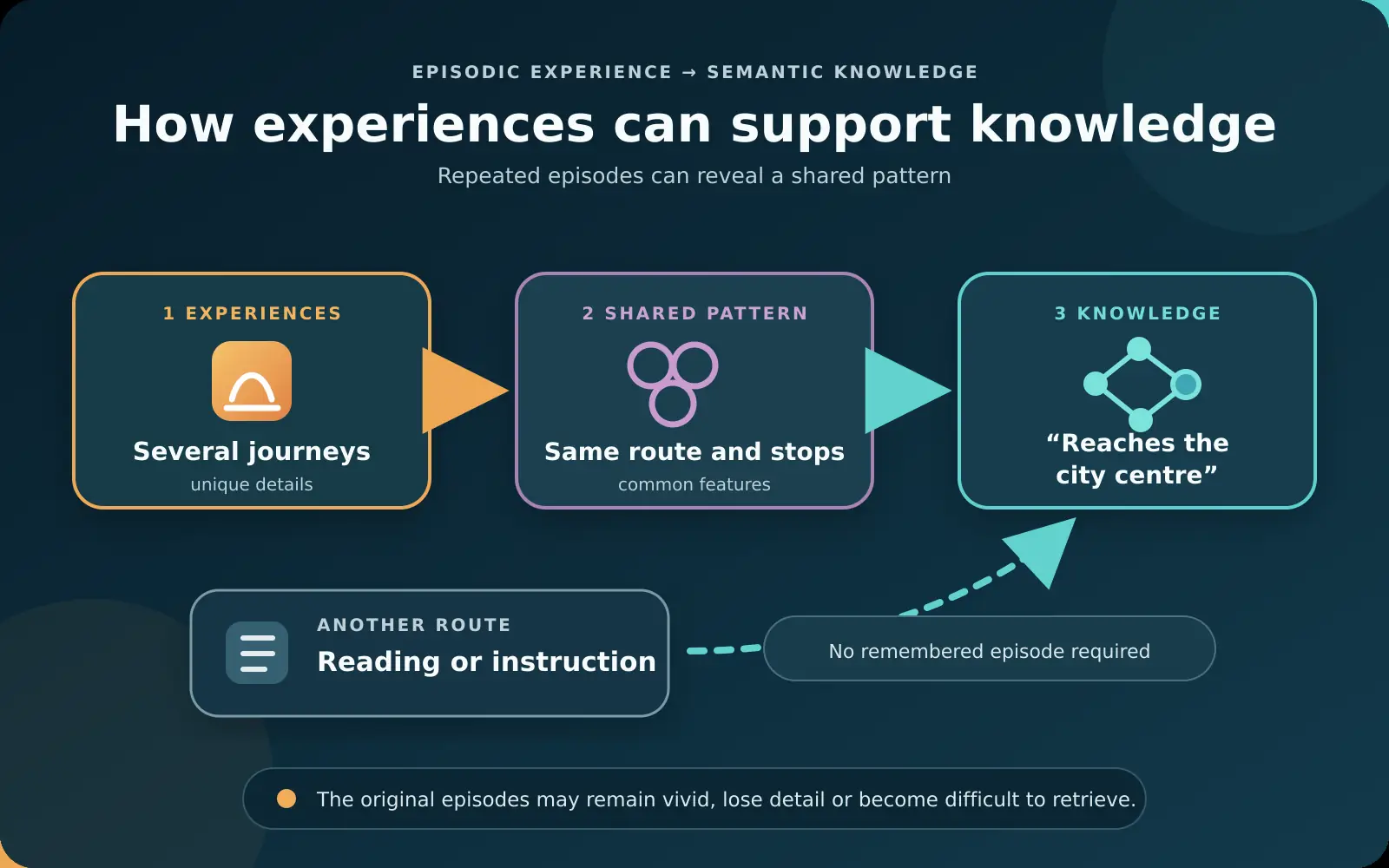
Sometimes the details of a learning episode fade while the knowledge remains. You may once have remembered the lesson in which you encountered a new term; later, only its meaning is accessible. Repeated experiences can also be distilled into general knowledge: after taking the same route many times, you know where it leads without retrieving a particular journey.
It is tempting to describe this as episodic memory simply “becoming” semantic memory. That is useful shorthand, but it is not a complete account.
Semantic knowledge can develop through several routes:
- extracting what is common across repeated episodes
- being told a fact directly
- reading or studying information more than once
- connecting new material with an existing concept
- remembering parts of an event while losing its source
Evidence from people with developmental amnesia shows why the relationship is not all-or-nothing. In one influential study, young people with early hippocampal pathology had profound episodic-memory difficulties yet acquired considerable factual knowledge. The authors concluded that episodic and semantic memory were partly dissociable. In another case, a person with severely impaired episodic memory gradually learned some new facts through repeated study, although learning was less efficient and source memory was poor.
The reverse caution matters too. The hippocampus is not irrelevant to semantic learning. Research involving adults who acquired bilateral hippocampal damage found reduced acquisition of new factual knowledge, suggesting that the hippocampal region supports new semantic learning even though well-established knowledge depends heavily on distributed cortical systems.
The most defensible conclusion is therefore modest: episodic experience is one important route into semantic knowledge, but the systems are neither identical nor fully independent.
For the broader processes that allow an experience or fact to persist, see how memories are formed.
Where Are Episodic and Semantic Memories Processed in the Brain?
There is no episodic drawer beside a semantic drawer. Both forms depend on networks, and those networks overlap.
Brain Networks Involved in Episodic Memory
The hippocampus and nearby medial-temporal structures are especially important for binding the elements of an event: who was present, what occurred, where it happened and how those details fit together. Deliberate episodic retrieval also engages regions in the prefrontal cortex, posterior cingulate cortex, precuneus, angular gyrus and other areas involved in control, imagery, self-reference and contextual reconstruction.
Damage affecting the hippocampal system can leave a person with a striking loss of event memory. Patient K.C., for example, retained many facts about himself and the world but could not consciously re-experience specific events from his life. Research with K.C. helped establish that a person can preserve autobiographical knowledge while losing the episodic scenes that once gave that knowledge context.
Brain Networks Involved in Semantic Memory
Semantic knowledge is represented across distributed regions that encode different features of concepts. Knowledge about a hammer may include its shape, the movement used to swing it, its typical sound and its relationship to nails and tools. Temporal, frontal and parietal areas contribute to retrieving and controlling this information.
The anterior temporal lobes are often described as important convergence regions that help integrate different features into coherent concepts. However, “the anterior temporal lobe” is not one uniform semantic module, and researchers continue to refine how its subregions and connections contribute to different kinds of knowledge.
Shared Network, Different Weightings
Brain imaging does not support a tidy map in which one region contains episodes and another contains facts. A PET study comparing autobiographical events with several forms of semantic knowledge found different patterns within a common retrieval network. More recent work similarly suggests that event memory, personal facts and general knowledge recruit overlapping processes in different proportions.
That is consistent with everyday remembering. An episode draws on semantic knowledge to identify people, objects and places. A concept can, in turn, activate images or personal scenes. The categories remain useful because the balance of context, reliving and conceptual knowledge differs, not because the brain keeps them in isolated compartments.
How Episodic and Semantic Memory Work Together
Neither system would be very useful alone.
Learning
Semantic knowledge gives new material somewhere to fit. If you already understand the structure of a cell, a new fact about mitochondria has conceptual connections. Episodic memory may preserve the example, demonstration or mistake that made the idea memorable.
Recognising a Situation
Suppose a colleague begins repeating an argument from last week. Semantic memory lets you understand the topic and language. Episodic memory tells you that this particular discussion has happened before and how it ended.
Making Decisions
General knowledge supplies rules and probabilities; remembered events supply concrete cases. Choosing a route may involve knowing which road is normally quickest and recalling the morning when roadworks caused a long delay.
Communicating
A bare episode can be confusing without background knowledge. A list of facts can be dry without an example. Conversation moves between the two: the event illustrates the point, and semantic knowledge makes the event intelligible.
Imagining What Comes Next
To picture a future event, the mind can recombine episodic details while respecting semantic knowledge about what is possible. You might imagine dinner at a restaurant you have never visited by drawing on remembered meals and general knowledge about restaurants.
What Happens to Episodic and Semantic Memory With Age?
The two forms do not necessarily change at the same rate. On average, healthy older adults tend to produce fewer context-specific episodic details than younger adults in autobiographical-memory tasks, while semantic knowledge can remain comparatively strong. The original Autobiographical Interview study found that older adults gave fewer event details and more semantic or otherwise non-episodic information.
That is a group pattern, not a way to judge one person’s memory. Vocabulary, knowledge, education, health, cueing and the personal importance of an event all affect performance. Semantic memory is not completely protected from age or disease, and episodic ability varies widely among people of the same age.
Normal difficulty recalling a detail also does not reveal which memory system is “broken”. The information may have received little attention, a useful cue may be missing, or competing memories may be getting in the way. The guide to why you may forget things easily explains those possibilities and when a change deserves medical attention.
Common Misunderstandings
“Episodic Means Emotional; Semantic Means Neutral”
An episode can be mundane, and semantic knowledge can carry strong emotion. You may have no feeling about where you left a receipt this morning, yet hold emotionally important knowledge about your family, culture or diagnosis. Emotion can influence both systems; it does not define the boundary.
“Semantic Memory Is Just Trivia”
Semantic memory includes far more than quiz answers. Vocabulary, categories, social concepts, numerical knowledge and the meanings of everyday objects all depend on it.
“If I Know Where I Learned It, the Fact Is Episodic”
The fact remains semantic; the recollection of learning it is episodic. Both can be retrieved together. Knowing that sodium has the symbol Na is semantic. Remembering your chemistry teacher writing it on the board is episodic.
“Every Personal Memory Is Episodic”
Facts about your own life can be personal semantic knowledge. “I have two sisters” does not require you to revisit a single event.
“The Two Memories Use Completely Separate Parts of the Brain”
They show different neural emphases, but they share substantial circuitry and interact during ordinary thought. A clean conceptual distinction should not be mistaken for a clean anatomical split.
For the larger map—including sensory, short-term, working, long-term and procedural memory—explore how psychologists classify memory.
Frequently Asked Questions
What Is Episodic Memory in Simple Terms?
Episodic memory is memory for a particular event you experienced. It usually includes some combination of what happened, where and when it occurred, and the sense that the event belongs to your own past.
What Is Semantic Memory in Simple Terms?
Semantic memory is knowledge of facts, meanings, concepts and relationships. You can use it without remembering the occasion on which you learned the information.
What Is the Main Difference Between Episodic and Semantic Memory?
Episodic memory reconstructs context-specific events; semantic memory provides knowledge that is not dependent on one specific learning context. Remembering your graduation ceremony is episodic. Knowing what a graduation ceremony is uses semantic memory.
Are Episodic and Semantic Memory Explicit or Implicit?
Both are usually classified as explicit or declarative long-term memory because their contents can be consciously accessed and reported. Procedural skills, priming and conditioning are commonly placed in the implicit or non-declarative branch.
Is Autobiographical Memory Episodic or Semantic?
It can be both. Autobiographical episodic memory concerns specific events from your life. Personal semantic memory includes facts about your identity and history without requiring you to relive a particular occasion.
Is Remembering a Name Episodic or Semantic Memory?
Knowing a person’s name is usually semantic knowledge. Remembering the moment when that person introduced themselves is episodic. A single act of recall may bring up both.
Is Remembering Where You Put Something Episodic or Semantic?
Usually episodic. You may retrieve the recent event of placing your keys on the counter. If you simply know that the counter is their usual place, that expectation is closer to semantic knowledge about your routine.
Can Semantic Memory Exist Without Episodic Memory?
To a degree. Cases of developmental amnesia show that people with severe episodic impairment can still acquire facts, especially through repetition. However, semantic learning may be slower or less flexible, and the hippocampal system can contribute to learning new knowledge. The systems can separate partly, not absolutely.
Does Episodic Memory Become Semantic Memory Over Time?
Sometimes a specific learning context fades while its factual or general meaning remains. Repeated episodes can also support knowledge about what usually happens. It is too simple, however, to claim that every episode automatically turns into a semantic memory.
Is Episodic Memory More Accurate Than Semantic Memory?
No. Episodic memory can contain vivid sensory detail and still be mistaken. Semantic knowledge can also be incorrect, outdated or misapplied. The two systems differ mainly in the form of information and the experience of retrieval, not in a guaranteed level of accuracy.
Which Brain Area Is Most Important for Episodic Memory?
The hippocampus is especially important for binding and retrieving the elements of episodic memories, but it acts within a wider network. No complex event memory is stored or reconstructed by one structure alone.
Which Brain Area Stores Semantic Memory?
Semantic knowledge depends on distributed cortical networks rather than one storage site. Temporal regions, including parts of the anterior temporal lobes, help integrate conceptual information, while frontal and parietal regions contribute to controlled retrieval and use.
Final Takeaway
Episodic memory lets you reconstruct a particular event from your life. Semantic memory lets you know facts, meanings and concepts without returning to the occasion on which they were learned.
The distinction is real, but the partnership matters just as much. Episodes are interpreted through existing knowledge. Knowledge can be built from repeated experiences, and a familiar fact can cue a personal scene. The brain does not keep the two in sealed containers; it draws on overlapping networks in different ways.
A useful question is therefore not only “Is this a fact or an experience?” Ask whether you are reliving one event, accessing knowledge, or doing what people usually do: using both at once.
References
- Tulving E. Episodic memory: From mind to brain. Annual Review of Psychology. 2002.
- Renoult L, Irish M, Moscovitch M, Rugg MD. From knowing to remembering: The semantic–episodic distinction. Trends in Cognitive Sciences. 2019.
- Vargha-Khadem F, Gadian DG, Watkins KE, Connelly A, Van Paesschen W, Mishkin M. Differential effects of early hippocampal pathology on episodic and semantic memory. Science. 1997.
- Levine B, Svoboda E, Hay JF, Winocur G, Moscovitch M. Aging and autobiographical memory: Dissociating episodic from semantic retrieval. Psychology and Aging. 2002.
- Maguire EA, Mummery CJ. Differential modulation of a common memory retrieval network revealed by positron emission tomography. Hippocampus. 1999.
- Rosenbaum RS, Köhler S, Schacter DL, et al. The case of K.C.: Contributions of a memory-impaired person to memory theory. Neuropsychologia. 2005.
- Bayley PJ, Hopkins RO, Squire LR. Semantic memory and the human hippocampus. Neuron. 2003.
- Gardiner JM, Brandt KR, Baddeley AD, Vargha-Khadem F, Mishkin M. Charting the acquisition of semantic knowledge in a case of developmental amnesia. Neuropsychologia. 2008.
- Tulving E, Hayman CA, Macdonald CA. Long-lasting perceptual priming and semantic learning in amnesia: A case experiment. Journal of Experimental Psychology: Learning, Memory, and Cognition. 1991.
- Addis DR, Wong AT, Schacter DL. Remembering the past and imagining the future: Common and distinct neural substrates during event construction and elaboration. Neuropsychologia. 2007.
- Tanguay AFN, Palombo DJ, Love BC, et al. The shared and unique neural correlates of personal semantic, general semantic, and episodic memory. eLife. 2023.
- Greenberg DL, Verfaellie M. Interdependence of episodic and semantic memory: Evidence from neuropsychology. Journal of the International Neuropsychological Society. 2010.
- Squire LR, Zola SM. Episodic memory, semantic memory, and amnesia. Hippocampus. 1998.
- Moscovitch M, Cabeza R, Winocur G, Nadel L. Episodic memory and beyond: The hippocampus and neocortex in transformation. Annual Review of Psychology. 2016.