


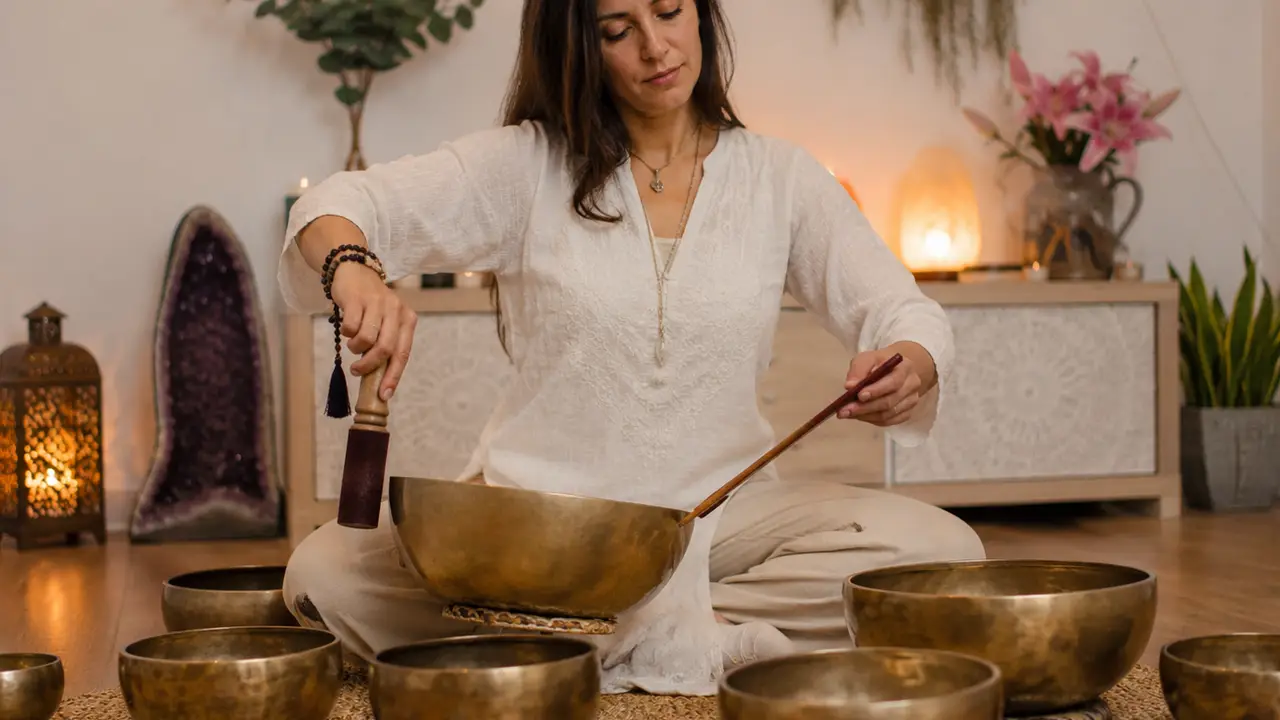
There is no single “correct” way to experience a singing bowl meditation.
You might feel deeply relaxed, notice your mind wandering, become emotional, fall asleep or feel very little at all. None of these responses means that you have succeeded or failed.
The most helpful approach is to enter the session with curiosity rather than expecting a particular outcome.
In Part 1 of my Himalayan singing bowl journey, I explored what singing bowls are, how they produce sound and what research currently suggests. This second part focuses on the experience itself: intentions, expectations, common sensations and how to practise safely.
My First Sound Meditation Session
My first formal sound meditation took place in a large hall arranged with cushions and blankets.
Before it began, I was nervous about remaining still for 45 minutes. Roadworks outside created a jarring contrast with the calm environment inside, and I wondered whether I would be able to concentrate.
Once the session started, my attention gradually moved towards the sounds of the bowls. Some tones were soft and distant. Others felt fuller and more immediate. I noticed individual sounds appearing, changing and fading into silence.
By the end, 45 minutes had felt closer to ten.
I did not have a dramatic vision or an out-of-body experience. I simply felt a profound sense of peace.
That experience taught me an important lesson: sound meditation does not need to produce something extraordinary to be worthwhile.
What Should You Expect During Singing Bowl Meditation?
A sound meditation session may involve one or several singing bowls, sometimes alongside bells, gongs or other instruments.
You will normally sit or lie down while a practitioner plays the instruments at a comfortable distance. In a self-guided session, you might strike one bowl gently and listen until its tone disappears.
The sound provides a focal point. When thoughts arise or your attention wanders, you can return to listening.
Your experience may be influenced by:
- the volume and type of sound;
- the length of the session;
- whether you are sitting or lying down;
- your mood and energy level;
- the environment around you;
- your familiarity with meditation;
- your personal response to particular tones.
Because these factors change, two sessions may feel completely different.
The aim is not to reproduce someone else’s experience. It is to notice your own response without forcing it to mean something.
Intention Versus Expectation
An intention is a gentle direction for your attention.
An expectation is a result you believe must happen.
For example:
- Intention: “I will notice each sound as it changes.”
- Expectation: “This session must remove my anxiety.”
The first creates a useful focus. The second can create pressure and disappointment.
You do not need to set an intention before sound meditation. Listening is enough. However, a simple intention can help if your mind feels scattered or you want to connect the session with a particular personal value.
An intention should not be treated as a promise that the session will change your health, emotions or circumstances.
Simple Intentions for Sound Meditation
Keep your intention short and flexible.
You could use:
- “I will return my attention to the sound.”
- “I am open to noticing what arises.”
- “I will treat myself with kindness.”
- “I will observe without immediately reacting.”
- “I give myself permission to pause.”
- “May I be happy and healthy.”
- “May someone I care about be happy and healthy.”
Choose one that feels natural. You do not need to repeat it constantly.
Set the intention at the beginning, then allow the sound to become your main focus.
Why an Intention May Help
A simple intention can:
- give your attention a clear direction;
- mark the transition from daily activity to meditation;
- help you return after distraction;
- connect the session with a personal value;
- encourage a less judgemental response to thoughts.
It does not make the practice more powerful or guarantee a deeper meditation. Some of my most valuable sessions have happened without any intention beyond listening.
Common Sound Meditation Experiences
Responses to sound meditation vary considerably. The table below explains some common experiences without assigning them a medical or spiritual meaning.
| Experience | What it may mean | What to do |
|---|---|---|
| Your mind wanders | Normal attention fluctuation | Return gently to the next sound |
| The effect feels subtle | Not every session feels profound | Continue without forcing a result |
| You feel relaxed | The setting and focused listening may feel calming | Notice the feeling without holding onto it |
| You become sleepy | You may be tired or comfortable | Rest, or sit upright if you want to stay alert |
| Emotions arise | Quiet attention can make feelings more noticeable | Acknowledge them without interpreting them immediately |
| Traffic distracts you | Environmental sound is competing for attention | Include it briefly, then return to the bowl |
| You notice tingling | Posture, pressure or focused attention may increase bodily awareness | Reposition if needed |
| You notice an ache | Your position may be uncomfortable | Move rather than enduring pain |
| You feel light or detached | Deep relaxation can sometimes feel unfamiliar | Open your eyes and reconnect with the room |
| You feel nothing unusual | This is completely normal | Let listening itself be the practice |
Physical or emotional sensations should not automatically be interpreted as energy blockages, trauma leaving the body or evidence that healing is taking place.
If a new symptom is persistent, painful or concerning, seek appropriate professional advice.
Is It Normal for Your Mind to Wander?
Yes.
Meditation does not require continuous concentration. Minds naturally move between sensations, memories, plans and distractions.
The practice happens when you notice that your attention has wandered and return to the sound.
You may do this dozens of times during one session. Each return is part of the meditation, not evidence that you are bad at it.
If you regularly struggle with racing thoughts, our guide to finding focus with a busy mind offers additional techniques.
Is It Normal to Fall Asleep?
Some people fall asleep during longer sound meditation sessions, especially when lying down.
This does not necessarily indicate an unusually deep meditation. You may simply be tired, comfortable or accustomed to relaxing in that position.
If your intention is to remain aware, try:
- sitting rather than lying down;
- keeping your eyes slightly open;
- choosing a shorter session;
- practising earlier in the day;
- avoiding an overly warm room.
If your intention is simply to rest and the setting is safe, falling asleep is not a failure.
Why Might Emotions Arise?
Reducing external activity can make existing thoughts and emotions easier to notice.
A sound, memory or moment of stillness may feel comforting, sad, frustrating or unexpectedly moving. This does not necessarily mean that the bowl has released a “stored emotion.”
Allow the feeling to be present without immediately creating an explanation for it.
If an emotion becomes overwhelming:
- Open your eyes.
- Notice the room around you.
- Feel your feet or body against the floor.
- Take a normal, unforced breath.
- End the session if you need to.
People with trauma histories or significant mental-health concerns may prefer to practise with an appropriately trained professional.
What About Tingling, Vibrations or Aches?
Focused attention can make ordinary physical sensations more noticeable.
You might become aware of:
- pressure from lying in one position;
- a limb beginning to feel numb;
- muscle tension;
- warmth or coolness;
- the physical vibration of a nearby bowl;
- a tingling sensation.
These experiences do not prove that energy is moving through the body or that a blockage is being cleared.
If something feels uncomfortable, change position. Meditation should not require you to remain still through pain.
What If Outside Noise Interrupts the Session?
My first sound meditation included roadworks outside the building. At first, the noise felt incompatible with the atmosphere inside.
Over time, I stopped treating it as an obstacle.
You can briefly notice an external sound—traffic, voices or construction—without following it. Then return to the next bowl tone.
This does not mean you must tolerate an unsuitable environment. A quieter setting will usually be easier for beginners. But occasional background noise does not have to ruin the session.
Experience Rather Than Achievement
One of the most useful principles I learned was:
Approach the session with a willingness to experience, not a need to achieve.
Trying to force relaxation often creates more tension. Waiting for a spiritual revelation can make a quiet but worthwhile session feel disappointing.
Instead, notice:
- What can I hear?
- Where is my attention?
- Has the sound changed?
- Can I notice the silence after it?
- Am I comfortable?
- Do I need to adjust my position?
These questions keep the practice grounded in direct experience.
Can Singing Bowl Meditation Heal You?
Singing bowl meditation should not be described as medical healing.
Some studies suggest that singing bowl sessions may support short-term relaxation or reduce self-reported tension for some participants. However, the research is still developing, and stronger controlled studies are needed.
There is no reliable evidence that a sound meditation can:
- diagnose physical or psychological problems;
- remove trauma from the body;
- clear physical blockages;
- repair cells;
- strengthen immunity;
- treat anxiety, depression or sleep disorders;
- replace medical or psychological care.
Some people use the word “healing” in a personal or spiritual sense. If that language is used, it should be clearly distinguished from medical treatment.
For a detailed evidence assessment, read Singing Bowl Meditation: What the Research Says.
How to Prepare for Your First Session
Before the session
- Choose a quiet, comfortable location.
- Wear clothing that does not restrict movement.
- Decide whether sitting or lying down feels better.
- Keep the volume gentle.
- Set an intention only if it feels helpful.
- Let go of the need for a particular result.
During the session
- Listen to one sound at a time.
- Notice how each tone changes and fades.
- Allow thoughts to pass without fighting them.
- Adjust your position if you feel pain or numbness.
- Open your eyes if you feel disoriented.
- Stop if the sound becomes uncomfortable.
After the session
- Sit quietly for a moment before standing.
- Notice how you feel without judging the result.
- Drink water if you are thirsty.
- Write down any useful observations.
- Avoid making medical conclusions from temporary sensations.
If you want to practise independently, see our guide to playing Himalayan singing bowls.
Choosing a Suitable Sound
Not everyone enjoys the same pitch, volume or instrument.
One bowl may feel calming to one listener and unpleasant to another. Personal preference matters more than claims that a particular frequency has a guaranteed effect.
When choosing a bowl or recording:
- listen at a low volume first;
- avoid harsh or uncomfortable tones;
- compare several sounds;
- consider the activity you are using it for;
- do not assume a labelled frequency has a special medical effect.
Our guide to finding the sound that suits you explores this in more detail.
Sound Meditation Safety
Use a comfortable volume and keep bowls away from the ears.
Stop the session if you experience:
- hearing discomfort;
- worsening tinnitus;
- dizziness;
- panic;
- significant distress;
- persistent pain;
- disorientation that does not pass quickly.
Take additional care if you have sound sensitivity, migraines, hearing difficulties or a condition that can be affected by intense sensory experiences.
Do not place a vibrating bowl directly on another person’s body without appropriate training, explanation and consent.
Sound meditation can complement daily relaxation practices. It should not replace treatment from a qualified healthcare professional.
Final Reflection
The magic of sound is not that it produces a guaranteed transformation.
It is that every listening experience is slightly different.
During one session, you may feel peaceful. During another, your mind may remain busy. You might notice a strong emotional response, or nothing more dramatic than the rise and fall of a resonant tone.
All of these experiences are valid.
My first session taught me that I did not need to leave my body, stop every thought or achieve a special mental state. I only needed to listen.
That remains my approach to singing bowl meditation: stay curious, avoid forcing an outcome and let the sound provide a place for attention to rest.
Frequently Asked Questions
Do I need to set an intention before sound meditation?
No. An intention can provide direction, but simply listening is enough. Avoid turning an intention into an outcome you believe must happen.
What should I feel during singing bowl meditation?
There is no required feeling. You may feel relaxed, distracted, sleepy, emotional or unchanged. Your response may also vary between sessions.
Is it normal to fall asleep?
Yes, particularly when lying down during a long session. If you want to remain alert, sit upright or choose a shorter practice.
Why did I become emotional?
Quiet attention can make existing feelings or memories more noticeable. This does not necessarily mean that the sound released a stored emotion.
What if I feel tingling or vibrations?
You may be noticing posture, pressure, circulation, focused attention or the physical vibration of a nearby bowl. Reposition yourself if the sensation becomes uncomfortable.
Can singing bowl meditation treat anxiety?
It should not be used as a treatment for anxiety. Some preliminary research suggests possible short-term relaxation benefits, but it is not a replacement for professional support.
How long should my first session be?
Start with five to ten minutes. Increase the duration gradually if the sound remains comfortable and you enjoy the practice.
References
- Cai Y, et al. Therapeutic effects of singing bowls: A systematic review of clinical studies. Explore. 2025.
- Goldsby TL, Goldsby ME, McWalters M, Mills PJ. Effects of singing bowl sound meditation on mood, tension, and well-being. Journal of Evidence-Based Complementary & Alternative Medicine. 2017;22(3):401–406.