


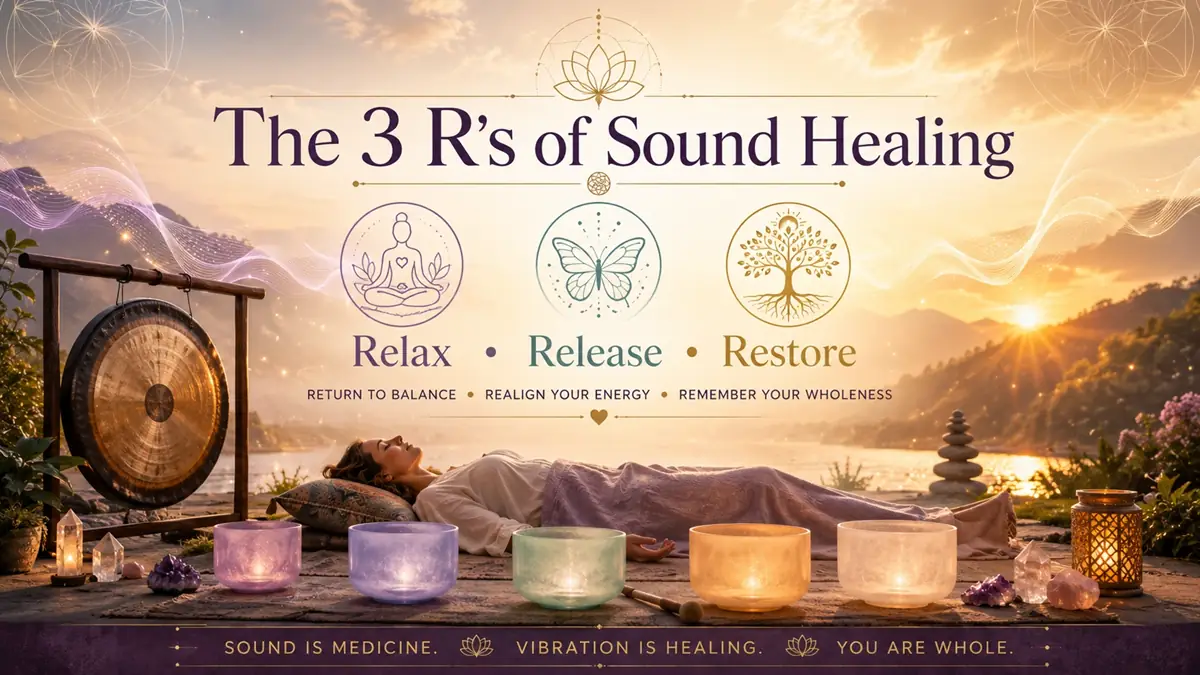
The 3 R’s of Sound Meditation are a simple reflection framework:
- Relax: Settle into the session without forcing an outcome.
- Recognise: Notice thoughts, emotions and physical sensations without immediately interpreting them.
- Respond: Choose a considered next step after the session.
This is an original practical framework, not an established clinical treatment or an ancient Himalayan teaching. It does not describe a sequence of cellular healing, emotional release or neurological rewiring.
Its purpose is simpler: to help you approach sound meditation with greater awareness and realistic expectations.
If you are preparing for your first session, begin with our guide to what to expect during singing bowl meditation.
Why Use a Reflection Framework?
Sound meditation can be open-ended.
Some people begin a session with a clear intention. Others simply want to rest or listen. During the practice, you might feel calm, distracted, emotional, sleepy or unchanged.
Without a clear framework, it can be tempting to assign a dramatic meaning to every response.
For example:
- tingling becomes “energy moving”;
- sadness becomes “stored trauma leaving”;
- relaxation becomes “nervous-system healing”;
- a difficult memory becomes proof of a hidden blockage;
- a resonant sound becomes evidence of cellular change.
These interpretations may feel meaningful, but they are not conclusions that can be drawn from the experience alone.
The 3 R’s encourage a more grounded approach: settle, observe and then decide whether any response is useful.
The Different Meanings of the 3 R’s
There is no universally recognised set of “3 R’s” in sound meditation.
Some practitioners use:
- Resonance
- Rhythm
- Relaxation
These words describe genuine features associated with sound, but they should be used carefully.
Resonance is a physical phenomenon in which a vibrating system responds strongly to particular frequencies. It does not demonstrate that a singing bowl heals cells or corrects an imbalance in the body.
Rhythm is a repeated pattern in sound or movement. Rhythmic stimulation can influence attention and produce measurable responses in the brain, but this does not mean that every repeated sound regulates heart rate or permanently synchronises brainwaves.
Relaxation is a possible response to listening, meditation and a comfortable environment. It varies between people and sessions.
The framework in this article uses different terms—Relax, Recognise and Respond—because they describe actions a listener can take without making unsupported claims about what the sound is doing inside the body.
R1: Relax
Relaxation is an invitation, not a requirement.
Trying to force yourself to relax can create more pressure. Instead, begin by making the environment as comfortable as reasonably possible.
You might:
- sit or lie in a supported position;
- lower the volume;
- remove avoidable distractions;
- loosen any unnecessary muscular tension;
- let your breathing continue naturally;
- choose a simple intention;
- listen to one sound at a time.
The aim is not to reach a special state. It is to give yourself enough space to notice the experience.
A simple relaxation prompt
Before the first sound, ask:
What can I make more comfortable right now?
The answer may be practical:
- adjusting a cushion;
- changing position;
- reducing the volume;
- moving further from the bowl;
- opening or closing your eyes;
- deciding not to set an intention.
Comfort is more important than remaining perfectly still.
What sound may contribute
A sustained tone can provide attention with a clear sensory object. Instead of trying to stop every thought, you can follow the sound as it appears, changes and fades.
For some people, this makes meditation feel more approachable.
However, a singing bowl does not guarantee relaxation. If you dislike a particular tone or find the volume uncomfortable, the sound may have the opposite effect.
Our guide to finding a suitable sound for meditation explains why personal preference matters.
R2: Recognise
The second step is to notice what is happening without immediately deciding what it means.
You might recognise:
- a thought repeatedly returning;
- an emotion becoming more noticeable;
- tension in your shoulders;
- discomfort from your position;
- impatience about the session;
- a pleasant sense of calm;
- tiredness;
- an urge to move;
- distraction from outside noise;
- no obvious change.
All are possible.
Recognition means describing the experience as clearly as you can.
Instead of:
“The bowl is releasing trauma from my body.”
Try:
“I noticed sadness and tension in my chest while listening.”
The second statement remains close to what you actually observed. It does not turn a temporary sensation into a diagnosis.
Observe before interpreting
A useful recognition sequence is:
- Name the experience: “I notice tension.”
- Locate it if physical: “It is in my shoulders.”
- Check its intensity: “It feels mild.”
- Notice whether it changes: “It softens when I move.”
- Avoid an immediate conclusion: “I do not yet know what caused it.”
This approach can help you remain curious without becoming alarmed or attaching an unsupported story to the sensation.
Common experiences and grounded interpretations
| Experience | Grounded observation |
|---|---|
| Tingling | A temporary physical sensation |
| Crying | An emotional response |
| Sleepiness | You may be tired or deeply comfortable |
| Wandering thoughts | Normal attention fluctuation |
| Feeling peaceful | A subjective response to the session |
| Feeling detached | A reason to open your eyes and reconnect with the room |
| Physical discomfort | A reason to change position |
| Feeling nothing | A normal response |
None of these experiences proves that energy, trauma or a physical blockage has been released.
R3: Respond
After recognising your experience, decide whether it requires a response.
A response does not need to be dramatic.
It might involve:
- changing your position;
- lowering the volume;
- taking a break;
- writing down an observation;
- resting;
- continuing with your day;
- having a considered conversation;
- returning to a personal boundary;
- arranging professional support;
- taking no action at all.
The aim is to choose rather than react automatically.
Questions to ask after a session
Try asking:
- What did I actually notice?
- What am I assuming about the experience?
- Did anything feel helpful?
- Did anything feel uncomfortable?
- Is there a small, sensible action I want to take?
- Does this require professional advice?
- Can I let the experience pass without assigning it a meaning?
Reflection can be useful, but not every thought or sensation needs to become a project.
A Ten-Minute 3 R’s Practice
You can apply the framework during a short self-guided sound meditation.
Minutes 1–3: Relax
Place the bowl securely on a cushion.
Sit comfortably and strike it gently. Follow the tone until it fades. Repeat slowly without trying to produce a particular state.
If you need technique guidance, read how to play a Himalayan singing bowl.
Minutes 4–7: Recognise
Continue listening while noticing:
- where your attention moves;
- whether your position remains comfortable;
- any thoughts or emotions;
- your response to the volume and pitch;
- whether you want to continue.
Describe what you notice without explaining why it is happening.
Minutes 8–10: Respond
Stop playing and allow the final tone to disappear.
Ask whether you want to:
- make a brief note;
- adjust something for next time;
- rest for another minute;
- finish the practice;
- seek advice about anything concerning.
Close the session without expecting a transformation.
Does Sound Meditation Release Emotions?
Emotions can become more noticeable during quiet or focused practices.
A memory may arise. You may cry, smile or feel unexpectedly unsettled. That response is real, but its presence does not demonstrate that sound has extracted or released a stored emotion from your cells.
Avoid deliberately trying to relive distressing experiences during an unsupervised sound session.
If difficult emotions become overwhelming:
- Stop the sound.
- Open your eyes.
- Notice your surroundings.
- Place your feet on the floor.
- Move to a comfortable position.
- Contact an appropriate professional if you need support.
Sound meditation should not be used as a substitute for trauma-informed psychological care.
Does Sound Meditation Rewire the Brain?
“Rewiring” is commonly used as shorthand for neuroplasticity—the nervous system’s capacity to change through learning and experience.
That does not mean one sound session rewires the brain or removes an unwanted emotional pattern.
Long-term changes in skills, habits and responses usually involve repeated behaviour, learning, context and time. A sound meditation might provide an opportunity to pause or reflect, but it should not be described as a neurological treatment.
For the third R, Respond is more accurate than Rewire. It focuses on an action you can choose without making a claim about a biological mechanism.
Is Sound Meditation Cellular Healing?
There is no reliable evidence that ordinary singing bowl meditation heals the body at a cellular level.
A singing bowl vibrates and produces sound waves. Those physical facts do not establish that it:
- repairs cells;
- removes toxins;
- releases stored emotions from tissue;
- clears physical blockages;
- strengthens immunity;
- restores a supposed cellular frequency.
Some clinical studies report possible short-term benefits for relaxation, mood or anxiety. However, the research is preliminary and does not validate cellular-healing claims.
Read our full assessment of singing bowl meditation research.
Guidance for Sound Meditation Practitioners
Practitioners have a responsibility to avoid imposing an interpretation on another person’s experience.
Avoid statements such as:
- “That pain is blocked energy.”
- “Your tears mean trauma is leaving.”
- “The bowl is rewiring your brain.”
- “Your body is detoxifying.”
- “This frequency is healing an organ.”
- “You need more sessions to complete the release.”
Instead, use neutral questions:
- “What did you notice?”
- “Was the volume comfortable?”
- “Would you like to change position?”
- “Would you prefer to pause?”
- “Do you want quiet time before discussing it?”
- “Is there any support you need?”
Do not diagnose, prescribe treatment or advise a participant to stop medical or psychological care.
When to Stop a Session
End or pause the practice if you experience:
- hearing pain;
- worsening tinnitus;
- dizziness;
- panic;
- significant distress;
- disorientation;
- persistent physical pain;
- a strong desire to leave.
Sound meditation is optional. Remaining in an uncomfortable session is not evidence of commitment or progress.
If a symptom is persistent or concerning, consult an appropriately qualified professional.
What the 3 R’s Can Realistically Offer
The framework may help you:
- enter a session with less pressure;
- separate observation from interpretation;
- respond more deliberately;
- communicate your experience clearly;
- recognise when something is uncomfortable;
- avoid exaggerated healing claims;
- connect meditation with a practical next step.
It is a reflection tool, not a treatment protocol.
Final Takeaway
The 3 R’s of Sound Meditation are:
- Relax without forcing a particular state.
- Recognise what you experience without immediately explaining it.
- Respond with a small, considered action—or no action at all.
Sound meditation does not need a story about cellular healing, blocked energy or neurological rewiring to be meaningful.
Listening closely, noticing honestly and responding thoughtfully can be enough.
Frequently Asked Questions
Are the 3 R’s an ancient sound-healing teaching?
No. Different practitioners use different combinations of words. Relax, Recognise and Respond is an original reflection framework, not an ancient Tibetan or Nepalese teaching.
Is the 3 R’s framework scientifically validated?
No. It has not been tested as a clinical intervention. It is a practical structure for reflection and responsible communication.
Can sound meditation release stored trauma?
There is no reliable evidence that sound extracts trauma from the body. Difficult emotions can become more noticeable during quiet practices, but trauma treatment requires appropriately qualified support.
Can singing bowls rewire the brain?
One session should not be described as rewiring the brain. Neuroplastic change normally involves repeated learning, behaviour and time.
Does rhythm synchronise brainwaves?
Rhythmic stimulation can produce measurable time-linked responses in the brain. That does not prove permanent synchronisation, emotional healing or a specific health benefit.
What if I feel nothing during the practice?
That is normal. Sound meditation does not need to produce a strong physical or emotional response to be a valid listening experience.
References
- Cai Y, et al. Therapeutic effects of singing bowls: A systematic review of clinical studies. Explore. 2025.
- Goldsby TL, Goldsby ME, McWalters M, Mills PJ. Effects of singing bowl sound meditation on mood, tension, and well-being. Journal of Evidence-Based Complementary & Alternative Medicine. 2017;22(3):401–406.
- Saskovets M, et al. Effects of sound interventions on the mental stress response in adults. 2025.