


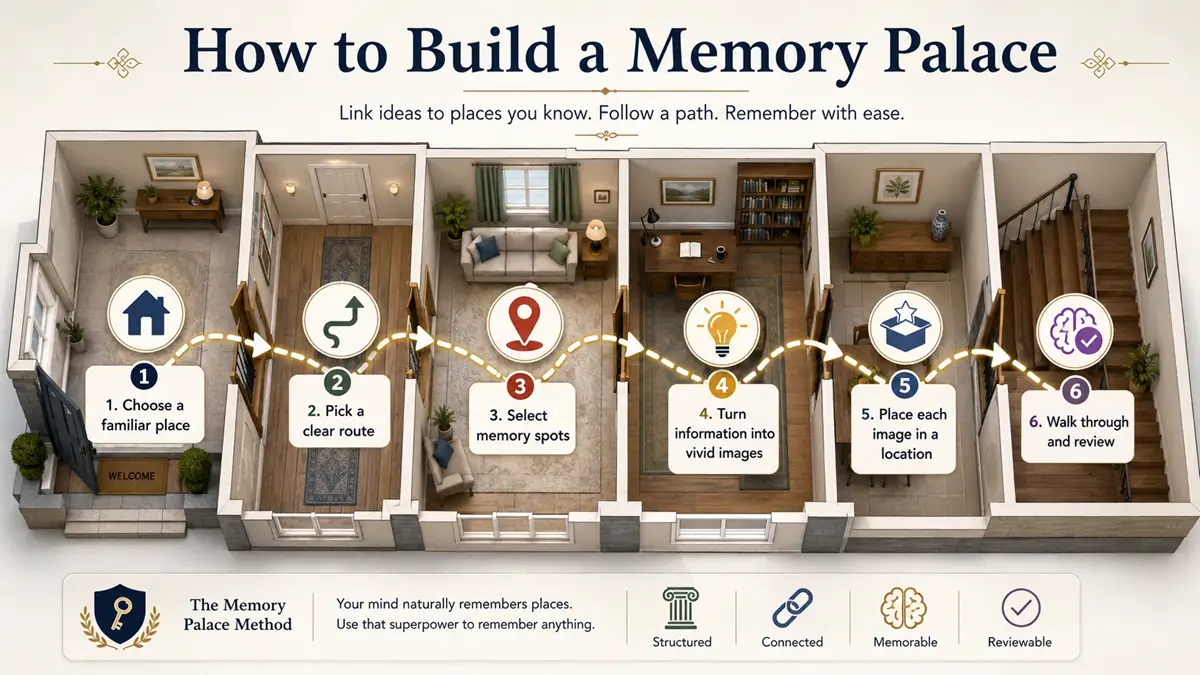
A memory palace is a simple memory technique where you place vivid mental images along a familiar route, then “walk” through that route to recall the information. You can build a basic memory palace in about 10 minutes, especially for lists, facts, speeches or study points. It works best for specific recall tasks, not as a magic upgrade for every part of memory.
The question most people ask before trying a memory palace is: can I really build one quickly, or is this just something memory champions do?
The honest answer is: yes, you can build a useful version quickly, but it works best when you use it for the right job. A memory palace can help you remember ordered information, key points, names, terms and lists. It will not automatically improve every part of working memory, attention or real-world cognition.
The surprising thing we see with brain training is that people often expect one “perfect” method. What actually happens is more practical: different methods train different skills. A memory palace is excellent for visual memory and recall. N-back is more about working memory and mental updating. Active recall and spaced repetition are better for long-term learning.
What a Memory Palace Means
A memory palace, also called the method of loci, is a mnemonic technique that uses familiar places to organise information.
Instead of trying to memorise a list by repeating it, you connect each item to a location you already know. That could be your bedroom, your walk to work, your kitchen, your school corridor or a favourite café.
The basic idea is simple:
- Choose a familiar place.
- Pick a clear route through it.
- Select memory spots along the route.
- Turn each piece of information into a vivid image.
- Place each image at one spot.
- Walk through the route and review.
This works because the method uses spatial memory, visual memory and association. Research describes the method of loci as a technique that relies on familiar spatial relationships, such as rooms, routes or landmarks, to arrange and later retrieve information.
The Honest Answer
A memory palace can improve your recall of the information you deliberately place inside it.
That distinction matters.
If you use a memory palace to remember 12 presentation points, you may recall those points more easily. If you use it to learn anatomy terms, historical dates or a shopping list, it can be very effective. But that does not mean it will automatically make you generally smarter, cure forgetfulness or improve every type of mental performance.
The research picture is similar for brain training more broadly. Training often improves performance on the task being practised, while transfer to broader, untrained abilities is more mixed.
So the honest answer is:
Use a memory palace when you need structured recall. Use brain training when you want short, focused cognitive practice. Use sleep, exercise, active recall and spaced repetition when you want better long-term learning habits.
What We Tested
This was a small NeuroLifts editorial test, not a formal scientific study. The goal was to see how practical a beginner-friendly memory palace felt when built and tested in 10 minutes.
| Test / game / method | Skill trained | What felt easy | What felt hard | Best for | Limitation |
|---|---|---|---|---|---|
| Memory palace in 10 minutes | Visual memory, recall, attention | Choosing a familiar home route was quick, and the first few images appeared naturally | The middle locations blurred slightly until the images became more exaggerated | Remembering ordered lists, study points, speeches or steps | Less useful for abstract understanding unless paired with explanation and recall |
| Vivid image creation | Pattern recognition, association, visual memory | Turning concrete words into images felt fast | Abstract terms like “working memory” needed extra effort to make visual | Turning dry facts into memorable cues | Images can blur together if they are too similar |
| Walk-through review | Recall, attention, mental clarity | The route made recall feel structured rather than random | One weak image disappeared during the first review | Testing recall without notes | Needs repetition to hold over time |
| NeuroLifts memory session | Working memory, focus, mental updating | The short format made it easy to stay engaged without feeling like a long study session | Accuracy dipped when the task required holding and updating information quickly | Short daily cognitive practice | Does not replace studying, sleep or healthy routines |
What I Tested
I tested whether I could build a simple memory palace in 10 minutes and use it to remember 10 items: the six memory palace steps plus four related learning terms — working memory, attention, active recall and spaced repetition.
How I Tested It
I used a familiar home route with 10 locations:
- Front door
- Hallway mirror
- Shoe rack
- Kitchen sink
- Fridge
- Kettle
- Sofa
- Desk
- Lamp
- Bedroom door
I gave each item a vivid image, placed one image in each location, walked through the route twice, then tested recall without looking at my notes.
What I Expected
I expected the first few items to be easy because the route was familiar. I thought the later items, especially the more abstract terms, would be harder to remember because they needed stronger images.
The reason this matters is that memory advice often sounds too polished. Real memory training is messier. Some images stick instantly. Some are weak. Some locations feel natural. Others are forgettable. That messiness is useful because it shows beginners what to adjust.
Step-by-Step: How to Build a Memory Palace
1. Choose a Familiar Place
Start with somewhere you know without thinking.
Good options include:
- Your home
- Your bedroom
- Your route to work
- Your school or university building
- A familiar gym, café or office
Do not choose somewhere impressive. Choose somewhere automatic.
Your first memory palace should feel boringly familiar. That is the point.
2. Pick a Clear Route
A memory palace works best when the route has a fixed order.
For example:
Front door → hallway → kitchen → sink → fridge → sofa → desk → bed
Avoid jumping around. The route should feel like a simple mental walk.
If you are using your home, start at the entrance and move in one direction. If you are using a commute, follow the real journey from start to finish.
3. Select Memory Spots
Memory spots are the exact places where you will attach information.
These are sometimes called loci.
Good memory spots are specific:
- Front door handle
- Shoe rack
- Kitchen sink
- Coffee machine
- Fridge door
- Sofa cushion
- Desk lamp
- Bathroom mirror
Weak memory spots are vague:
- Kitchen
- Bedroom
- Outside
- Work
The more specific the spot, the easier it is to retrieve the image later.
4. Turn Information into Vivid Images
This is the part beginners often skip.
A memory palace does not work well if you place plain words in locations. You need images.
For example, if you want to remember “focus”, do not place the word “focus” on your sofa. Imagine a giant camera lens sitting on the sofa, zooming in and out.
If you want to remember “active recall”, imagine someone shouting quiz questions from your fridge.
If you want to remember “spaced repetition”, imagine flashcards spread across the stairs at increasing distances.
The more visual, strange and physical the image, the better.
5. Place Each Image in a Location
Now attach one image to each spot.
For example, if you are remembering the six memory palace steps:
- Front door: a giant map choosing your familiar place.
- Hallway: arrows painted on the floor showing your route.
- Shoe rack: glowing dots marking memory spots.
- Kitchen sink: a cartoon brain turning words into wild images.
- Fridge: each image stuck to the door like a magnet.
- Sofa: you walking through the whole route with a checklist.
The order matters. Your route becomes the structure.
6. Walk Through and Review
Close your eyes and mentally walk through the palace.
Do not just admire the images. Test yourself.
Ask:
- What is at the front door?
- What is in the hallway?
- What is on the shoe rack?
- What comes next?
- Which image feels weak?
Then walk through again.
A memory palace becomes stronger when you retrieve it, not when you simply reread it. This is where active recall matters.
What I Found
This was not a formal scientific test, but it was useful as a quick beginner experiment.
- Number of items tested: 10
- Immediate recall score: 9 out of 10
- Recall after a short delay: 8 out of 10
- Most memorable image: a giant camera lens on the sofa to represent focus and attention
- Weakest location: the kettle, because the image placed there was too ordinary
- Main lesson: the route gave structure, but the strength of each image determined whether the item stuck
What stood out was that I did not forget items randomly. I forgot the item attached to the weakest image. That made the fix obvious: make the image bigger, stranger or more active.
A boring image disappeared. A ridiculous image stayed.
That is why “apple on the table” is weaker than “a giant apple exploding through the kitchen table while spraying juice across the room”.
The Unexpected Finding
What surprised me was that the memory palace itself was not the hardest part.
Choosing the route took less than a minute. The harder part was turning abstract ideas into images that were vivid enough to recall later.
“Choose a familiar place” was easy to picture. “Working memory” was harder. I had to imagine a waiter balancing too many plates at once to make the idea visual.
That was the useful discovery: the technique works best when the image is concrete, moving and slightly exaggerated.
Beginners often think the palace itself does all the work. In practice, the palace gives structure, but the images do much of the sticking. If an image is too small, too abstract or too similar to another image, it is harder to recall.
This is also why memory palaces are better for some tasks than others.
They work well for:
- Lists
- Ordered steps
- Key points
- Vocabulary
- Names
- Speech outlines
- Study prompts
They are less complete on their own for:
- Deep understanding
- Problem solving
- Essays
- Complex concepts
- Applying knowledge in new situations
For those, combine the memory palace with active recall, spaced repetition and practice questions.
What Works Best for Beginners
For beginners, the best memory palace is small.
Start with 5 to 10 memory spots. Do not build a giant mental cathedral.
The best beginner route is:
- Familiar
- Linear
- Specific
- Easy to visualise
- Free from repeated similar locations
The best beginner information is:
- A list
- A process
- A speech outline
- Definitions
- Study prompts
- Names and details
Memory Palace vs N-Back vs Spaced Repetition
A memory palace is best for structured recall.
N-back-style exercises are more focused on working memory and mental updating.
Spaced repetition is best for keeping information available over time.
Active recall is best for testing whether you can retrieve information without looking.
The best option depends on the goal. If you need to remember a speech tomorrow, try a memory palace. If you want to practise attention and working memory for a few minutes, use a focused brain-training session. If you are studying for an exam, combine active recall and spaced repetition with your memory palace.
Common Mistakes
Mistake 1: Choosing an Unfamiliar Palace
Do not invent a fantasy castle for your first attempt.
Use your real kitchen before you use an imaginary Roman temple.
Mistake 2: Making the Images Too Polite
Polite images are forgettable.
Make them oversized, emotional, moving, noisy or absurd.
Mistake 3: Using Vague Locations
“Bedroom” is too broad.
“Left pillow”, “desk chair” and “wardrobe handle” are better.
Mistake 4: Placing Too Much in One Spot
One location should usually hold one main image.
If you overload a spot, recall becomes messy.
Mistake 5: Reviewing by Rereading
A memory palace improves when you walk through it from memory.
That means recall first, notes second.
Mistake 6: Expecting It to Replace Learning
A memory palace helps you retrieve cues.
It does not automatically explain the meaning behind them.
How NeuroLifts Approaches This
At NeuroLifts, our view is that memory training is most useful when it feels short, focused and repeatable.
A 10-minute memory palace test is useful because it removes the pressure. You are not trying to become a memory athlete. You are practising attention, visual memory, recall and mental organisation in a small window of time.
The question users usually ask is:
“How long do I need to practise before I notice anything?”
The honest answer is that some techniques, like a memory palace, can feel useful immediately for a specific task. Broader changes in focus, attention or working memory need more consistent practice and should not be treated as guaranteed.
What I noticed from using NeuroLifts was that the short session format made the practice feel easier to start. Instead of needing a full study block, I could treat memory training as a small daily exercise. The most useful part was the feedback loop: focus, try, notice where attention slips, then repeat.
NeuroLifts is not built around the claim that one game will transform your brain overnight. The more practical goal is to give you short daily sessions that help you practise focus, memory, attention, recall, pattern recognition and mental clarity.
Try a short NeuroLifts memory session and see how your attention, recall and mental updating feel today.
Our Take
Our view is that brain training is most useful when it is treated like a short focused practice, not a miracle cure.
A memory palace can be genuinely helpful for remembering specific information. Brain-training games can help you practise particular skills, such as attention, working memory, visual memory or pattern recognition. But the best results come when these tools sit inside a wider learning routine.
That means combining cognitive training with:
- Sleep
- Exercise
- Active recall
- Spaced repetition
- Reduced distractions
- Real study or work practice
This is the honest middle ground.
Memory techniques can help with trained material. Brain-training games can help you practise specific tasks. But broader transfer to everyday cognition is more uncertain and should not be overclaimed.
A Simple Routine to Try Today
Here is a 10-minute memory palace routine you can try now.
Minute 1: Choose the Place
Pick your home, bedroom, office or route to the shop.
Minute 2: Choose the Route
Select 6 to 10 locations in a fixed order.
Example:
Door → shoes → mirror → desk → chair → lamp → bed → wardrobe
Minutes 3–5: Create Images
Turn each thing you want to remember into a vivid image.
Make it strange enough to stick.
Minutes 6–7: Place the Images
Put each image in one location.
Do not rush this. Make the image interact with the place.
Minutes 8–9: Walk Through
Mentally walk through the route and recall each item.
Notice weak spots.
Minute 10: Test Without Looking
Write down what you remember.
Then check your notes.
After testing, I would recommend starting with one small memory palace of 6 to 10 locations. Use it for a real task, such as a presentation outline, study list or set of key terms. Then review it later using active recall and spaced repetition rather than relying on one quick run-through.
Does This Actually Improve Memory?
A memory palace can improve memory for the information you encode into it, especially ordered lists, names, facts, speech points and study prompts. It is not a guaranteed improvement to every kind of memory. Think of it as a technique for better recall, not a complete brain upgrade.
How Long Should I Practise?
Start with 10 minutes. That is enough to build a small memory palace, test recall and notice what works. For longer-term retention, revisit the palace later the same day, the next day and again after a few days. Short, repeated practice is usually better than one long session.
What Is the Best Option for Beginners?
The best beginner option is a familiar route with 5 to 10 memory spots. Your home is usually better than an imaginary palace. Use concrete images, not abstract words. If you are also studying, combine the memory palace with active recall and spaced repetition so you are not just remembering cues, but strengthening knowledge.
What Should I Avoid?
Avoid making the palace too large, choosing unfamiliar places or using dull images. Also avoid expecting a memory palace to do everything. It can help with recall, but it will not replace understanding, practice questions, good sleep or focused study. If two images feel similar, make one bigger, stranger or more emotional.
How Does NeuroLifts Help?
NeuroLifts helps by turning cognitive practice into short daily sessions. Instead of relying on one technique, it gives you structured ways to practise memory, attention, focus, recall and mental updating. It works best when used alongside good learning habits, such as active recall, spaced repetition, sleep and reduced distractions.
Final Takeaway
A memory palace is one of the most beginner-friendly memory techniques because it uses something you already have: familiar places.
In 10 minutes, you can build a simple route, place vivid images inside it and test your recall.
The key is to stay realistic.
A memory palace can help you remember specific information more clearly. It is not a cure-all, and it does not replace learning. But as part of a wider brain-training and study routine, it is practical, fast and surprisingly satisfying.
Try a short NeuroLifts memory session and see how your attention, recall and mental updating feel today.
FAQ
Does this actually improve memory?
A memory palace can improve memory for the information you encode into it, especially ordered lists, names, facts, speech points and study prompts. It is not a guaranteed improvement to every kind of memory. Think of it as a technique for better recall, not a complete brain upgrade.
How long should I practise?
Start with 10 minutes. That is enough to build a small memory palace, test recall and notice what works. For longer-term retention, revisit the palace later the same day, the next day and again after a few days. Short, repeated practice is usually better than one long session.
What is the best option for beginners?
The best beginner option is a familiar route with 5 to 10 memory spots. Your home is usually better than an imaginary palace. Use concrete images, not abstract words. If you are also studying, combine the memory palace with active recall and spaced repetition so you are not just remembering cues, but strengthening knowledge.
What should I avoid?
Avoid making the palace too large, choosing unfamiliar places or using dull images. Also avoid expecting a memory palace to do everything. It can help with recall, but it will not replace understanding, practice questions, good sleep or focused study. If two images feel similar, make one bigger, stranger or more emotional.
How does NeuroLifts help?
NeuroLifts helps by turning cognitive practice into short daily sessions. Instead of relying on one technique, it gives you structured ways to practise memory, attention, focus, recall and mental updating. It works best when used alongside good learning habits, such as active recall, spaced repetition, sleep and reduced distractions.
Suggested Internal Links
- What Is Working Memory?
- Working Memory vs Short-Term Memory
- How to Improve Working Memory
- Do Brain Training Games Actually Improve Memory?
- The Best Memory Techniques to Remember More of What You Study
- Spaced Repetition to Remember More While Studying
- Active Recall to Remember More While Studying